

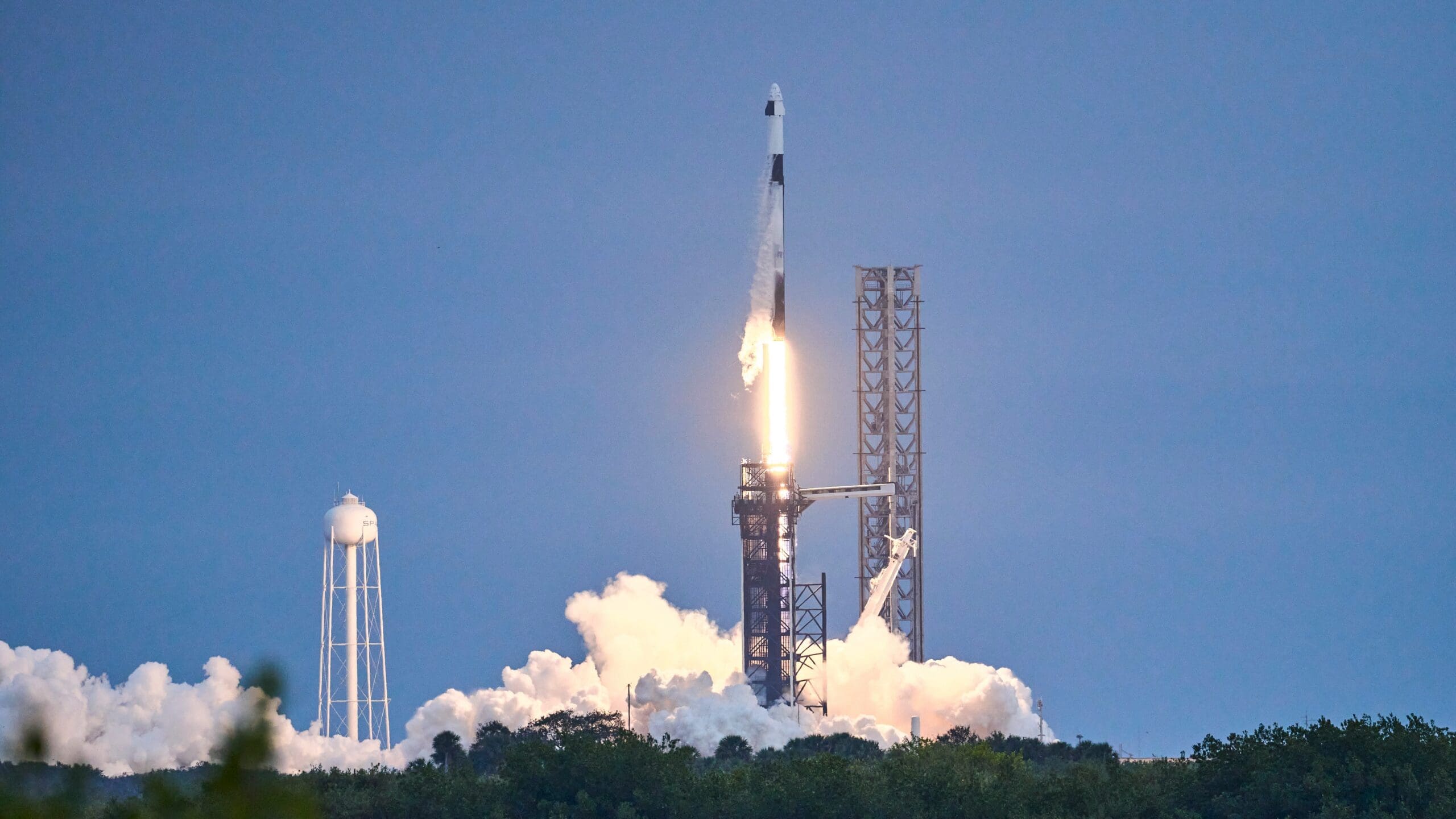
The SpaceX initial public offering (IPO) is dominating market headlines as thousands of investors are getting ready to participate in what’s expected to be the biggest IPO in stock market history.
Elon Musk’s rocket and satellite company is set to list on the Nasdaq stock exchange this Friday, under the ticker SPCX, and at an IPO price of $135 per share. It’s aiming to raise roughly $75bn, comfortably eclipsing Saudi Aramco’s $29bn IPO back in 2019, which previously held the record.
In fact, demand for the IPO has reportedly hit around $150 billion — around double the shares available.
But for long-term investors, particularly those holding exchange-traded funds (ETFs), the more important question isn’t what will happen to SpaceX stock on listing day. It’s what this IPO could actually mean for the funds already sitting in your portfolio.
How do IPOs perform long term?
The excitement around a major IPO is understandable. But before investing, it’s worth looking at how IPOs tend to fare over the long term.
Research from Professor Jay Ritter at the University of Florida — one of the world’s leading authorities on IPOs — shows that over a roughly 45-year period, IPOs have averaged a 19% first-day return. This is what’s often known as the opening ‘pop’.
However, it’s worth bearing in mind that the investors who benefit most are those who receive shares at the IPO price. Investors buying after trading starts may be buying after much of the first-day gain has already happened.
What’s less talked about is what happens next.
IPOs can be especially volatile after listing.
A study by LPL Financial of nearly 1,500 US IPOs from 1995 to 2025 found that the median IPO was down 4.7% one year after its first-day close. But the journey was often much rougher than that headline figure suggests, with the median IPO suffering a maximum drawdown of 48% during its first year of trading.
In other words, even IPOs that eventually recover can expose investors to sharp falls soon after listing.
That fits with other economic evidence from Professor Ritter. He showed that over a three-year holding period, IPOs have historically underperformed broader market benchmarks. Ritter’s landmark study found that the average IPO returned around 34% over the three years after listing — while a comparable set of stocks returned nearly 62% over the same period.
It’s important to remember that these are averages and not every stock will perform the same after the IPO. However, it’s a good reminder that when investing it’s important to focus on the long-term fundamentals and try to ignore any hype. And remember, past performance isn’t a guide to the future and no returns are ever guaranteed.
Investing in individual stocks is a lot riskier than index funds that track the market. So if you are buying stocks on their own, it’s important to make sure you understand exactly how the company makes money and have belief in its long-term strategy.
That’s because when you buy stocks, you’re backing yourself to beat the market. You’re pitting yourself against teams of professional investors who spend thousands of hours a week analysing these stocks — and even then most professionals still don’t beat the market over the long term.
Why ETFs are great for long-term portfolios
SpaceX IPO and the S&P 500, Nasdaq-100: what it means for your ETFs
This is where things get more interesting for passive investors. Because you may end up holding SpaceX in your portfolio whether you choose to or not — and the timeline and scale of how much you end up holding depends entirely on which index your ETFs track.
Will SpaceX join the Nasdaq-100?
It’s expected that Nasdaq-100 investors will see SpaceX enter their funds the fastest.
In May 2026, Nasdaq updated its inclusion rules to allow any newly-listed company ranked among the top 40 by market cap to enter the index after just 15 trading days. SpaceX will qualify easily given its size, putting the likely inclusion date around the end of June or early July.
However, because SpaceX is expected to float only around 4% of its total shares (Elon Musk retains tight control), Nasdaq’s new methodology allows for a weighting multiplier of up to 3x the float.
That means Nasdaq-100 ETF investors could end up with significantly more SpaceX exposure than the size of the available share pool would naturally suggest.
Estimates put the effective Nasdaq-100 weighting at somewhere between 0.4% and 0.7% — which translates to roughly £470–£700 of SpaceX exposure for every £100,000 held in a Nasdaq-100 tracker.
Will SpaceX join the S&P 500?
S&P 500 investors are insulated for now.
S&P Global confirmed in early June that it’s not changing its inclusion rules. The existing criteria stand — that means a 12-month seasoning period, four consecutive quarters of positive GAAP earnings, and a minimum investable float.
SpaceX, which reported losses in its most recent filings, cannot enter the S&P 500 until at least mid-2027, and only if it turns profitable in the interim.
So if you hold a fund tracking the S&P 500, SpaceX isn’t something you’ll need to factor into your portfolio until then.
How the SpaceX IPO could affect stock markets
The scale of the SpaceX IPO is expected to create some unusual market dynamics.
When SpaceX enters the Nasdaq-100, passive funds tracking that index will be forced to sell existing holdings — Apple, Microsoft, Nvidia and others — to make room.
Estimates suggest the combined forced buying across Nasdaq-100 and Russell index trackers could reach somewhere between $22 billion and $27 billion. That’s a significant amount of demand concentrated over a short window, which could drive up SpaceX’s price — but equally put downward pressure on the stocks being trimmed.
There’s also the retail and institutional side. Many investors who want a piece of SpaceX could well be raising cash by selling other positions to take part in the IPO.
This kind of selling — spread across markets and asset classes — means we could potentially see some market volatility.
SpaceX is also unlikely to be the last mega-IPO of this kind. Both OpenAI and Anthropic are reported to be planning public offerings this year.
And if they follow SpaceX into the Nasdaq-100 on an accelerated timeline, the cumulative effect on passive funds, and the stocks being displaced, could be considerable.
What the SpaceX IPO means for your investments
For most long-term investors, the answer is less dramatic than the headlines suggest.
But it’s worth taking a moment to understand what you actually hold.
If your portfolio includes a Nasdaq-100 tracker, you’ll soon have SpaceX exposure. If you hold a global ETF or an S&P 500 tracker, that exposure likely won’t arrive until at least mid-2027 at the earliest.
Neither position is inherently right or wrong. SpaceX could be one of the defining companies of the next decade. But it’s also entering the public markets at a premium valuation, in an environment where market valuations are already at record highs.
However what we do know is that the investors who tend to build wealth over time aren’t the ones chasing the biggest and latest IPOs. They’re the ones who tend to ignore the noise, stay invested, and let the compounding work its magic over the long term.
Top 10 most popular ISA ETFs UK investors bought in May 2026
How to buy ETFs easily with InvestEngine
InvestEngine makes it straightforward to invest in top ETFs, whether you’re building a long-term portfolio or adding a few new funds for diversification.
Why use InvestEngine?
✅ No trading or platform fees
Buy and sell ETFs commission free, so more of your money stays invested and working for you (ETF costs apply).
✅ Powerful portfolio tools
Track your holdings, compare ETFs, and rebalance whenever you need — all in one simple dashboard.
✅ Automate your investing
Set up a Savings Plan to invest regularly, choosing how much and how often. It’s an easy way to stay consistent and build wealth over time.
✅ Flexible account options
Invest through an ISA, SIPP, general investment account, or business account — all with no platform fees on DIY portfolios.
Important information
Capital at risk. The value of your investments may go down as well as up, and you may get back less than you invest. Past performance is not indicative of future performance.
ETF costs apply. If in doubt, you may wish to consult a professional adviser for guidance.