


July seemed to be defined by a single question: is the AI spending boom still worth what markets are paying for it?
Big tech’s own earnings beat expectations, and investors punished the sector anyway — turning sharply on the infrastructure spending that’s underpinned two years of gains, with semiconductor and tech names taking the brunt of it.
Nowhere was that dominance clearer than in South Korea.
What happened to South Korea’s stock market in July 2026?
An AI-fuelled boom in memory chip stocks reversed so violently it triggered back-to-back trading halts — a first in the market’s history — before snapping back just as fast within days.
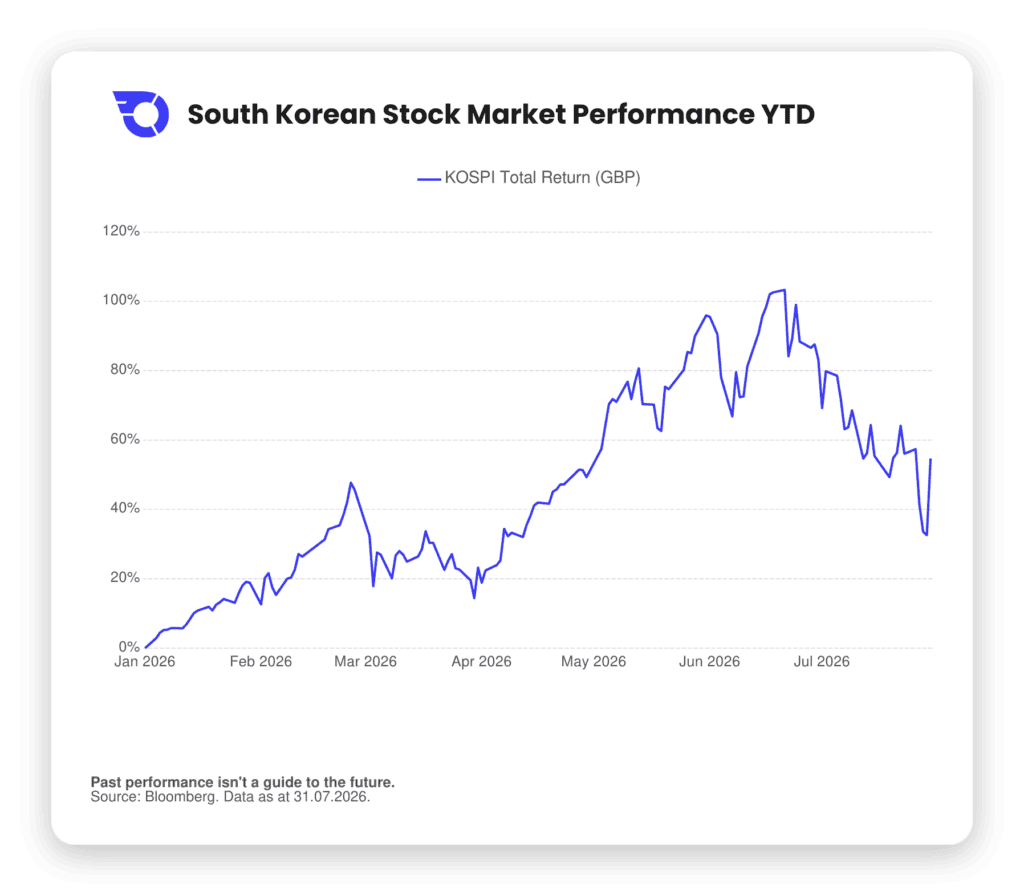
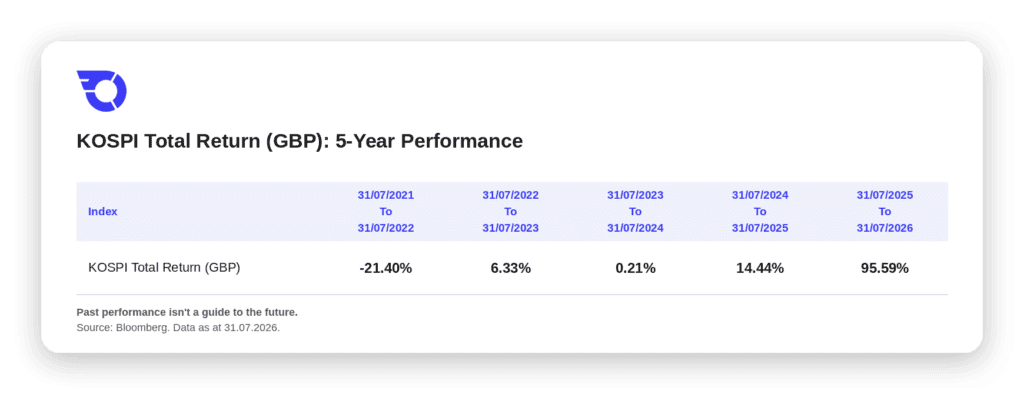
South Korea’s KOSPI had been up over 100% year-to-date at its 22 June high, driven by the same AI and memory chip enthusiasm lifting markets elsewhere. It then fell almost 16% over three trading days at the end of July, before rebounding nearly 17% in a single session — still leaving the index up close to 55% for the year.
However, among the biggest losers here were South Korean retail investors.
The main culprit? Leverage.
Single-stock leveraged ETFs, which multiply a stock’s daily ups and downs, launched in South Korea in May and quickly became extremely popular with retail traders.
An article by ProfGMedia stated that by early July, Samsung, SK Hynix and the leveraged ETFs tracking them made up 70% of all trading value on the market. Retail investors made up an estimated 92% of holders, and estimates suggest they lost around $38.7 billion between them. In fact by mid-July, roughly 1.2 million South Koreans (3.4% of the adult population) had received a margin call (a broker’s demand to add cash or sell holdings immediately, after borrowing money to invest).
Here’s a simplified example of how leverage can lead to deeper losses. Take an index that rises 10% one day, then falls 10% the next:
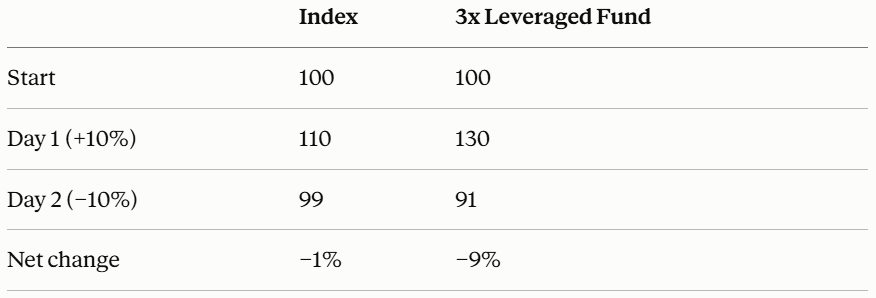
The index ends down just 1% — but the leveraged fund is down 9%, not the ‘3x’ of −3% you might expect. This is what turned an index correction into real losses for retail traders.
Remember, this is just an example for illustration purposes only.
What happened to the AI hedge fund Situational Awareness in July 2026?
Leverage was also causing chaos in the US.
You might have seen that a heavily-leveraged AI hedge fund, Situational Awareness, got caught out and was forced to offload its entire public portfolio at a discount — going from around $45bn to just $10bn, a loss of over 75% in just a month.
This likely made both the fall and the rebound sharper than they’d otherwise have been.
However, amidst all of this, markets recovered well and the US stock market has continued to rally into August, even after digesting a more hawkish Federal Reserve than expected under its newly installed chair.
What happened to the UK stock market in July 2026?
In the UK, the Bank of England was increasingly split over the inflation risk coming from the conflict in the Middle East.
However, UK markets held up well and enjoyed a strong month with energy and defence stocks rallying.
Do prime ministers actually move stock markets?
What are July’s 2026 stock market takeaways for investors?
This was a concentrated sell-off, not a broad one, and it was another reminder of just how dangerous holding leveraged positions can be — it’s why we don’t offer them on the InvestEngine platform.
In fact, when you look past the leverage you realise that most stocks outside AI and chips held up just fine — a reminder that a scary headline number doesn’t always tell the whole story, but also why diversification matters and that time in the market, as ever, matters more than trying to time it.
So with that being said, where have InvestEngine investors been putting their money in July?
The 10 most bought ETFs on InvestEngine in July 2026
This list ranks the most bought ETFs on InvestEngine — by number of net trades — from 1 July to 31 July 2026.
1. Vanguard FTSE All-World
This ETF invests in a broad range of companies across both developed and emerging markets worldwide. It includes a variety of large and mid-sized firms from numerous sectors, such as technology, healthcare, finance, and consumer goods.
By tracking a specific index, this ETF aims to reflect the overall performance of global stock markets, encompassing companies from regions including North America, Europe, and Asia.
2. Vanguard S&P 500
This ETF aims to replicate the performance of the S&P 500 index, offering investors diversified exposure to the 500 largest companies in the United States.
This ETF gives investors access to US companies, where it could benefit from the overall growth and success of these companies, without having to invest in each one individually.
3. Invesco FTSE All-World
This ETF offers investors the opportunity to invest in a wide range of companies from across the globe, including both developed and emerging markets. It aims to mirror the performance of the FTSE All-World index, providing diversified exposure to the world’s stock markets.
4. iShares Physical Gold
iShares Physical Gold is an exchange-traded commodity (ETC) that gives investors a way to invest in physical gold by following the daily price of gold. It does this by owning gold bars.
This ETC might appeal to investors looking to include gold in their portfolio, without needing to hold it physically. Remember though, investing in a specialist area like this adds risk, so it should only form a small part of a well-diversified portfolio.
5. Vanguard FTSE Emerging Markets
The Vanguard FTSE Emerging Markets ETF invests in a wide range of large and mid-sized companies in emerging markets across the globe.
Emerging markets are economies that are in the process of rapid growth and industrialisation, often offering higher growth potential compared to developed markets. The fund provides exposure to a diverse array of industries and countries, including China, India, Brazil, and South Africa, giving investors the opportunity to benefit from the economic expansion in these regions.
This ETF could appeal to investors looking to diversify their portfolios with long-term growth opportunities and are comfortable with the higher risks that come with investing in emerging markets.
6. Vanguard FTSE Developed World
The Vanguard FTSE Developed World ETF invests in a broad selection of companies from developed markets around the world, providing exposure to a diverse range of industries and regions. It tracks an index that includes large and mid-sized companies across North America, Europe, and the Asia-Pacific region.
7. Amundi Smart Overnight Return GBP Hedged
This ETF aims to achieve short-term returns higher than the benchmark rate SONIA with extremely low volatility. SONIA stands for ‘Sterling Overnight Index Average’, and is the average interest rate banks lend money to each other overnight.
The ETF can help offer a lower-risk place to keep money, compared to investing directly in the stock market, with the possibility of a little more growth than a more traditional savings account might offer.
8. iShares MSCI World Small Cap
The iShares MSCI World Small Cap allows investors to gain exposure to smaller companies from around the world.
Smaller companies have the potential to grow faster than larger ones, but are also riskier as their performance can be more volatile.
9. Vanguard Global Aggregate Bond
This ETF invests in a diversified portfolio of global bonds, including government and corporate bonds. The fund aims to track an index that represents the performance of investment‑grade bonds from around the world.
The bonds included in the portfolio have different maturities and come from various regions, offering broad exposure to the global bond market.
This ETF may appeal to investors looking for a globally diversified bond investment while helping to reduce the risk that comes with investing in other currencies.
10. Vanguard FTSE 100
The Vanguard FTSE 100 ETF seeks to track the performance of the FTSE 100 Index and is comprised of large‑sized company stocks in the UK. This ETF tracks the performance of the index by investing in every single investment that makes up the FTSE 100 and in the same proportion as the index.
This ETF could appeal to investors who are looking for focused exposure to the UK stock market, while benefiting from diversification across major industry sectors.
What should you consider before buying an ETF?
When comparing ETFs, it’s worth digging a little deeper than recent returns.
Start by looking at what the fund actually tracks. A global index like the FTSE All-World spreads your money across thousands of companies, while something more focused, like the S&P 500, tilts heavily toward the US and big tech names. Knowing the index helps you understand where your money is really going.
Costs matter too. Most ETFs are already low cost, but even a small difference in fees can add up over time, especially if you’re investing regularly. Larger funds also tend to trade more smoothly, which can save you money when buying or selling.
Finally, think about how the ETF fits into your wider portfolio. Is it a core holding you plan to build around, or a focused addition that targets a theme like gold or fixed income? Getting that mix right can make a big difference to how your portfolio performs and how comfortable you feel holding it through market ups and downs.
For more information on each ETF, check out its factsheet where you can also find its Key Investor Information Document.
Hotter than the Nasdaq-100? 3 tech ETF themes to watch in 2026
What are the risks of buying ETFs?
ETFs make investing simple, but they still come with risk. Markets move, and prices can fall just as easily as they rise. Even broad funds can drop in value during periods of uncertainty.
Some ETFs are concentrated in certain regions or sectors, which can amplify both gains and losses. Diversification helps smooth the ride, but it can’t remove risk completely. Currency movements can also affect returns on international funds, even when the underlying companies are performing well.
The key is to understand your goals and what you own and why. Short-term market moves then become less stressful and your investing decisions more consistent — which is often what matters most in the end.
How do you buy ETFs in the UK?
InvestEngine makes it straightforward to invest in top ETFs, whether you’re building a long-term portfolio or adding a few new funds for diversification.
Why use InvestEngine?
✅ No trading or platform fees
Buy and sell ETFs commission free, so more of your money stays invested and working for you (ETF costs apply).
✅ Powerful portfolio tools
Track your holdings, compare ETFs, and rebalance whenever you need — all in one simple dashboard.
✅ Automate your investing
Set up a Savings Plan to invest regularly, choosing how much and how often. It’s an easy way to stay consistent and build wealth over time.
✅ Flexible account options
Invest through an ISA, SIPP, general investment account, or business account — all with no platform fees on DIY portfolios.
Important information
Capital at risk. The value of your investments may go down as well as up, and you may get back less than you invest. Past performance is not indicative of future performance.
ETF costs apply. Remember, ISA and tax rules can change and any benefits depend on individual