


We’re six months into 2026 and UK investors have already seen the FTSE 100 reach record-breaking highs, a conflict in the Middle East, an oil spike and a full market recovery.
So which funds did they actually buy?
Here are the most popular ETFs in the UK so far this year, ranked by net buys on InvestEngine between 1 January and 30 June — plus a look at the market events behind the choices.
What happened in markets in the first half of 2026?
For UK investors, 2026 got off to a hot start.
The FTSE 100 broke through 10,000 for the first time ever, before climbing even higher to just short of the 11,000 mark.
Then came the US-Iran conflict towards the end of February.
The price of oil started to soar and it wasn’t long before it was well over $100, reigniting inflation fears. As global markets were gearing up for fresh interest rate cuts before the conflict, this came as quite a surprise.
As a result, markets fell, with US tech stocks taking the brunt of it. That’s because inflation, especially when it’s unexpected, can lead to sharp interest rate rises. And for stocks where valuations depend heavily on how much money they’re expected to make in the future, higher interest rates make these future cashflows look less valuable.
Higher interest rates can also make borrowing more expensive, slow down how much people spend, and hurt economic growth — none of which helps businesses make more money.
Following weeks of growing uncertainty, ceasefires and talks of peace then started to filter through to markets and green shoots of recovery started to appear. In fact, by mid-April, most markets were above where they were before the conflict.
However, it wasn’t a smooth ride. Some markets recovered quicker than others, and this is where the lesson lies for investors.
Which stock markets have performed best in 2026 so far?
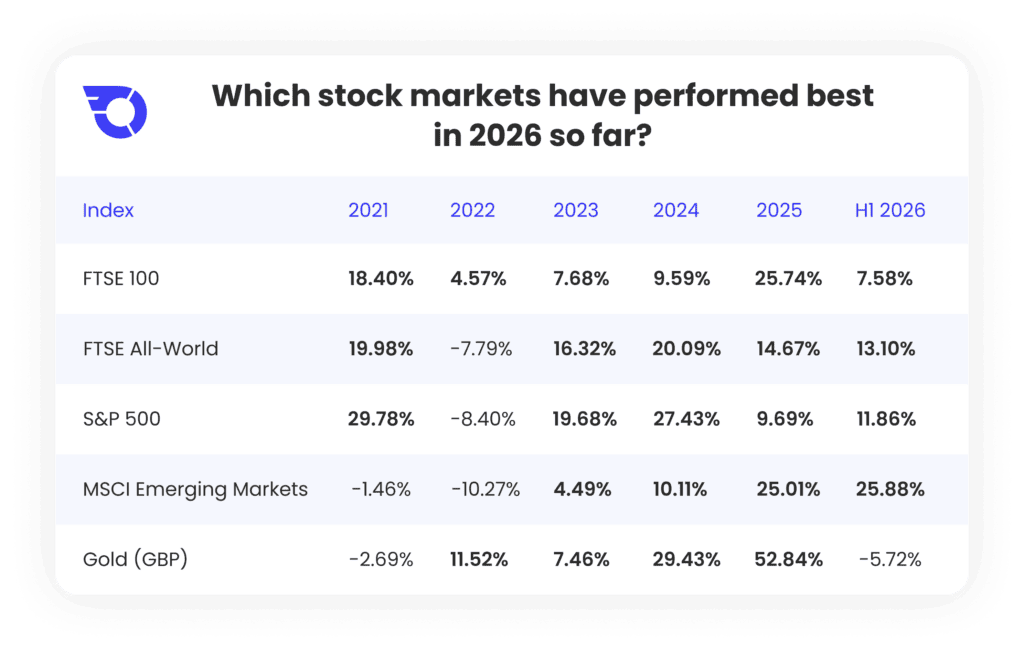
Past performance isn’t a guide to the future. Returns in GBP. Source: Bloomberg, 30/06/2026.
A table like this is an important reminder to not just chase ‘the winners’, because strong performance in the months or years before doesn’t automatically guarantee more success.
You just have to look at the gold price to see this. It delivered fantastic returns in 2025, but it’s struggled so far this year.
However, it’s also a great reminder of the importance of holding a diversified portfolio. This can mean holding hundreds of stocks across different sectors, countries and currencies all over the world.
The S&P 500 is a good example here.
In 2025, the US stock market did very well, but for UK investors holding unhedged versions of the S&P 500, a weaker US dollar dented returns.
However, on the other side of the coin, a weaker dollar can benefit emerging market stocks, which is part of the reason for their strong performance in 2025.
The goal is to try and make sure that your investments don’t all move together — when some fall, hopefully you’ll have others that do better to help pick up the slack.
5 ETF ideas for a Stocks and Shares ISA in 2026
So, what are the most popular ETFs in the UK in 2026?
This list ranks the most bought ETFs on InvestEngine — by number of net trades — from 1 January to 30 June 2026.
1. Vanguard S&P 500
This ETF aims to replicate the performance of the S&P 500 index, offering investors diversified exposure to the 500 largest companies in the United States.
This ETF could help investors get access to the US stock market, where it could benefit from the overall growth and success of these companies, without having to invest in each one individually.
2. Vanguard FTSE All-World
This ETF invests in a broad range of companies across both developed and emerging markets worldwide. It includes a variety of large and mid-sized firms from numerous sectors, such as technology, healthcare, finance, and consumer goods.
By tracking a specific index, this ETF aims to reflect the overall performance of global stock markets, encompassing companies from regions including North America, Europe, and Asia.
This ETF could help diversify a portfolio by offering exposure to global markets, including both developed and emerging economies.
3. Invesco FTSE All-World
This ETF offers investors the opportunity to invest in a wide range of companies from across the globe, including both developed and emerging markets. It aims to mirror the performance of the FTSE All-World index, providing diversified exposure to the world’s stock markets.
By investing across different countries and sectors, this ETF could help offer a lower risk way to benefit from broad global market growth.
4. iShares Physical Gold
iShares Physical Gold is an exchange-traded commodity (ETC) that gives investors a way to invest in physical gold by following the daily price of gold. It does this by owning gold bars.
This ETC might appeal to investors looking to include gold in their portfolio, without needing to hold it physically. Remember though, investing in a specialist area like this adds risk, so it should only form a small part of a well-diversified portfolio.
5. Vanguard FTSE Emerging Markets
The Vanguard FTSE Emerging Markets ETF invests in a wide range of large and mid-sized companies in emerging markets across the globe.
Emerging markets are economies that are in the process of rapid growth and industrialisation, often offering higher growth potential compared to developed markets. The fund provides exposure to a diverse array of industries and countries, including China, India, Brazil, and South Africa, giving investors the opportunity to benefit from the economic expansion in these regions.
This ETF could appeal to investors looking to diversify their portfolios with long-term growth opportunities and are comfortable with the higher risks that come with investing in emerging markets.
6. Vanguard FTSE Developed World
The Vanguard FTSE Developed World ETF invests in a broad selection of companies from developed markets around the world, providing exposure to a diverse range of industries and regions. It tracks an index that includes large and mid-sized companies across North America, Europe, and the Asia-Pacific region.
This ETF might appeal to investors looking for global diversification through a single investment, allowing them to gain exposure to well-established companies in developed economies.
7. Amundi Smart Overnight Return GBP Hedged
This ETF aims to achieve short-term returns higher than the benchmark rate SONIA with extremely low volatility. SONIA stands for ‘Sterling Overnight Index Average’, and is the average interest rate banks lend money to each other overnight.
The ETF can help offer a ‘safer’ place to keep money, compared to investing directly in the stock market, with the possibility of a little more growth than a more traditional savings account might offer.
8. Xtrackers MSCI World Quality
This ETF is designed to provide exposure to global companies that are considered to have high‑quality characteristics.
It tracks an index that selects companies based on factors like profitability, stable earnings, and low levels of debt.
The goal is to focus on firms that are financially strong and have the potential to perform well over time, regardless of short‑term market fluctuations.
By emphasizing these quality factors, the ETF seeks to offer investors a portfolio of companies that are more resilient during economic downturns or periods of market stress.
9. iShares FTSE 100
The iShares FTSE 100 ETF aims to track the performance of the FTSE 100 index, which is made up of the 100 largest publicly-traded companies in the UK.
It might appeal to investors looking for exposure to a broad range of leading UK companies across different industries.
10. SPDR S&P 500
This ETF aims to track the performance of the S&P 500 Index, which includes 500 of the largest publicly traded companies in the United States.
These companies span various sectors such as technology, healthcare, consumer goods, and financials, making it a broad representation of the U.S. stock market.
The companies in the S&P 500 are generally large, established businesses with strong market positions, and they are often considered leaders in their respective industries.
This ETF could appeal to investors who want a simple and diversified way to invest in some of the most well‑known and influential companies in the U.S., and it is often used as a core holding in a diversified portfolio.
What should you consider before buying an ETF?
When comparing ETFs, it’s worth digging a little deeper than recent returns.
Start by looking at what the fund actually tracks. A global index like the FTSE All-World spreads your money across thousands of companies, while something more focused, like the S&P 500, tilts heavily toward the US and big tech names. Knowing the index helps you understand where your money is really going.
Costs matter too. Most ETFs are already low cost, but even a small difference in fees can add up over time, especially if you’re investing regularly. Larger funds also tend to trade more smoothly, which can save you money when buying or selling.
Finally, think about how the ETF fits into your wider portfolio. Is it a core holding you plan to build around, or a focused addition that targets a theme like gold or fixed income? Getting that mix right can make a big difference to how your portfolio performs and how comfortable you feel holding it through market ups and downs.
For more information on each ETF, check out its factsheet where you can also find its Key Investor Information Document.
Hotter than the Nasdaq-100? 3 tech ETF themes to watch in 2026
What are the risks of buying ETFs?
ETFs make investing simple, but they still come with risk. Markets move, and prices can fall just as easily as they rise. Even broad funds can drop in value during periods of uncertainty.
Some ETFs are concentrated in certain regions or sectors, which can amplify both gains and losses. Diversification helps smooth the ride, but it can’t remove risk completely. Currency movements can also affect returns on international funds, even when the underlying companies are performing well.
The key is to understand your goals and what you own and why. Short-term market moves then become less stressful and your investing decisions more consistent — which is often what matters most in the end.
How do you buy ETFs in the UK?
InvestEngine makes it straightforward to invest in top ETFs, whether you’re building a long-term portfolio or adding a few new funds for diversification.
Why use InvestEngine?
✅ No trading or platform fees
Buy and sell ETFs commission free, so more of your money stays invested and working for you (ETF costs apply).
✅ Powerful portfolio tools
Track your holdings, compare ETFs, and rebalance whenever you need — all in one simple dashboard.
✅ Automate your investing
Set up a Savings Plan to invest regularly, choosing how much and how often. It’s an easy way to stay consistent and build wealth over time.
✅ Flexible account options
Invest through an ISA, SIPP, general investment account, or business account — all with no platform fees on DIY portfolios.
Important information
Capital at risk. The value of your investments may go down as well as up, and you may get back less than you invest. Past performance is not indicative of future performance.
ETF costs apply. Remember, ISA and tax rules can change and any benefits depend on individual circumstances. If in doubt, you may wish to consult a professional adviser for guidance.