


Summary
Saving keeps your money stable and easy to access, which suits emergency rainy-day funds and short-term goals. Investing aims for higher growth over the long term, but the value of your money can fall as well as rise. The right choice depends on your goals, your timeframe and how comfortable you are with risk. Many people do both.
What is the difference between saving and investing?
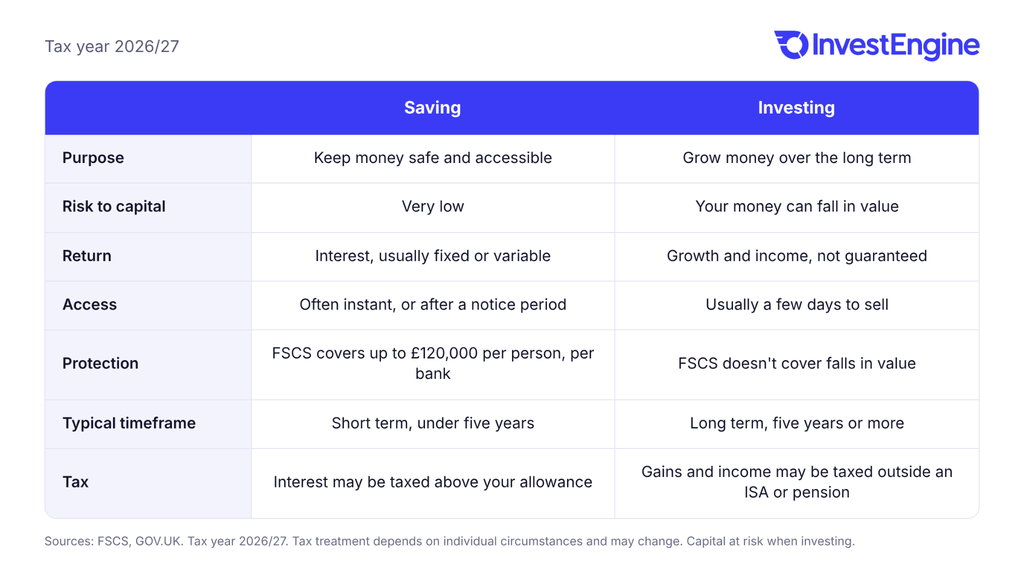
The main difference between saving and investing is risk. Saving keeps your money safe and earns interest, while investing puts your money into assets such as shares, which could grow more over time but can also fall in value.
What is saving?
Saving is putting money into a bank or building society account where it earns interest. Depending on what you’re saving for, you can pick between easy-access accounts or fixed terms, like 6 to 12 months or even longer like 5 years. Unlike investing, the value of your money doesn’t go down because of market movements, but if the rate you choose doesn’t keep pace with inflation then you could still lose spending power.
The interest rate can be fixed for a set period or variable, so it moves with the market – often following the Bank of England’s Bank Rate.
Savings with UK banks, building societies and credit unions are protected by the FSCS (Financial Services Compensation Scheme) up to £120,000 per eligible person, per bank, from 1 December 2025. This protects you if the bank fails, not against inflation.
What is investing?
Investing is buying assets, like shares in companies or exchange-traded funds (ETFs), with the aim of growing your money over the long term. But unlike cash, the value of investments can fall as well as rise, so you could get back less than you put in.
Many people invest through ETFs. An ETF is a low-cost fund that usually tracks a market index, such as a global share index, so one ETF can give you exposure to hundreds or thousands of companies from across the world.
Investments can make money in two ways: growth, when their value rises, and income, such as dividends paid by companies. Because prices move up and down, investing is generally better suited to goals that are at least five years away.
What are the risks of saving and the risks of investing?
Both saving and investing carry risks, but they’re different kinds.
The main risk to savings is that inflation can erode what your money can buy. The main risk to investments is that their value can fall.
Risks of saving
- Inflation risk. If prices rise faster than the interest you earn, your money buys less over time.
- Interest rate changes. Variable rates can fall, reducing what you earn.
- Tax on interest. Interest above your Personal Savings Allowance is taxed, unless it’s in a Cash ISA.
Risks of investing
- Market falls. The value of your investments can drop, sometimes sharply.
- Volatility. Prices move up and down, sometimes daily, which can be unsettling.
- No guarantee. Returns aren’t guaranteed, and past performance is not a reliable guide to future returns.
My investments have dropped: should I sell or hold?
How much tax do you pay on savings and investments?
How much tax you pay on savings and investments depends on your income and your allowances. In the 2026/27 tax year, savings interest, dividends and gains each have their own tax-free allowance, and anything held in an ISA is tax-free.
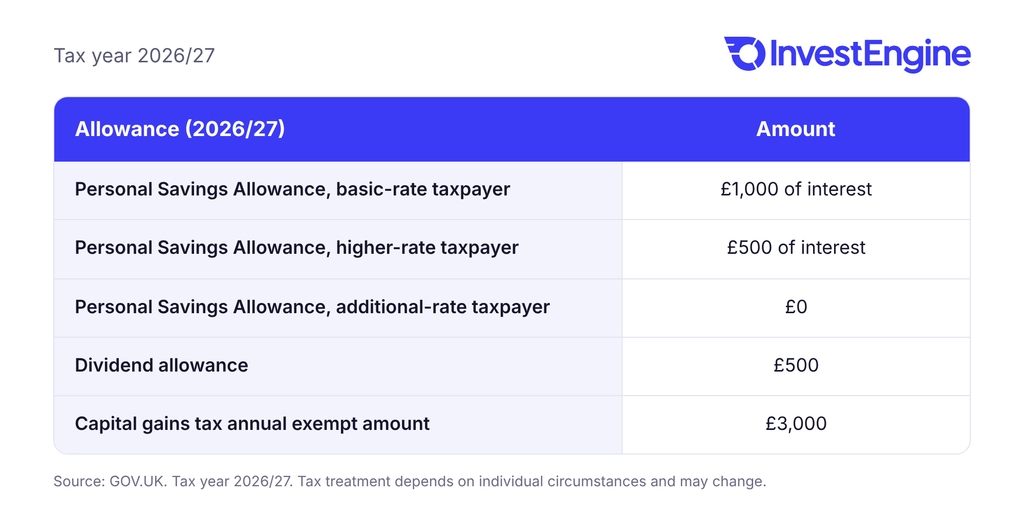
Interest, dividends and gains inside an ISA are tax-free, and you don’t need to report them. Your £12,570 Personal Allowance also applies to all your income, including savings interest.
How long should you save or invest for?
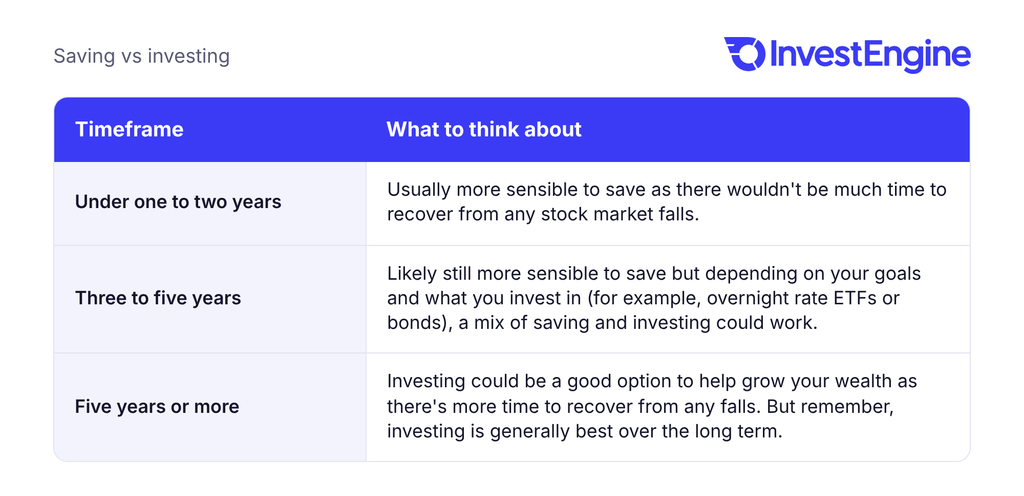
How long you have before you need your money is one of the most important factors in choosing between saving and investing.
In general, the shorter your timeframe, the more saving may suit you, and the longer it is, the more investing may suit you. What’s best for your circumstances will depend on your own goals and how much risk you’re happy taking.
Should you build an emergency fund before investing?
It’s generally considered more sensible to build an emergency fund in cash before thinking about investing. An emergency fund, often referred to as a rainy-day fund, is there to help pay for any unexpected emergencies, like a broken boiler. It means you can pay for unexpected costs without having to sell investments at a potentially bad time.
A common guideline is to keep three to six months of essential spending in an instant-access savings account. If your essential spending is £2,000 a month, that would mean £6,000 to £12,000.
Worked example: £10,000 saved vs invested over 10 years
These examples show how saving and investing could play out differently over 10 years. They use simple, hypothetical growth rates chosen for illustration only. They’re not forecasts, and they ignore charges and tax.
Jessica saves £10,000 in a savings account and assumes 3% interest a year, added every year for 10 years.
- After 10 years, she would have £13,439.
- If prices also rose by 3% a year, that £13,439 would buy about the same as £10,000 did at the start.
Ben invests £10,000 in a global ETF. Because investment returns aren’t fixed, here are three hypothetical scenarios over 10 years:
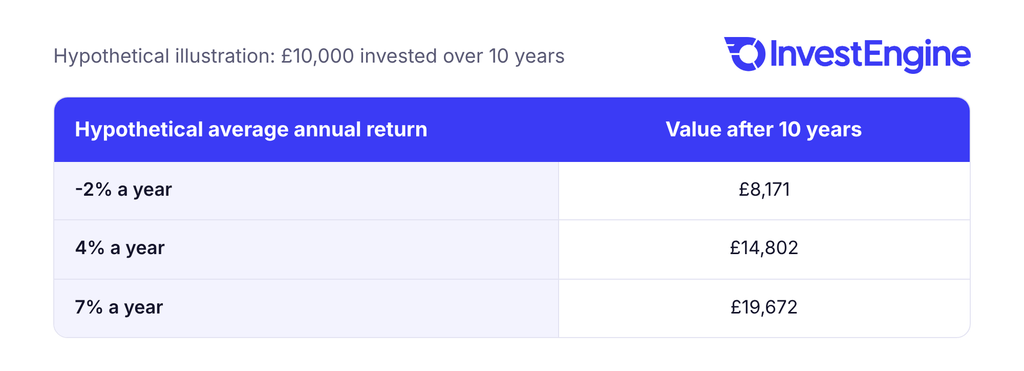
Ben’s result could be better or worse than any of these, and returns are unlikely to be smooth from year to year. Jessica’s outcome is more predictable, while Ben’s could be higher or lower.
These figures are illustrations, not forecasts. The value of investments can fall as well as rise, and past performance is not a reliable guide to future returns.
Can you do both?
Yes. Many people save and invest at the same time, using each for different goals. A simple approach is to keep cash for short-term needs and invest money for the long term.
For example, you might keep an emergency fund and a holiday fund in savings, and invest for retirement or for goals more than five years away.
How you split your money depends on your goals, timeframes and how comfortable you are with risk.
Which is right for you?
The right choice depends on what the money is for and when you’ll need it. Here are some examples. Remember though, they are just examples and won’t be right for everyone.
- If you have expensive debts, paying them off will probably be the best place to start. Debt interest usually costs more than you could earn.
- If you don’t have an emergency fund yet, saving might then be a good next step. It gives you a cash buffer for any unexpected costs.
- If you need the money within a few years, saving may be better. Your money stays stable and easy to access. And for money you know you won’t need soon, you can always consider fixing it for a set period to potentially get a better rate.
- If your goal is five years or more away, investing could be a good option. There’s more time to ride out falls.
- If you can’t accept any fall in value, saving might be better. Investing always carries some risk.
- If you have both short and long-term goals, a mix could be wise. Use savings for one and investments for the other.
How does a Stocks and Shares ISA fit in?
A Stocks and Shares ISA is the usual tax-efficient home for investing in the UK. Any growth, dividends and interest inside it are tax-free, and you can invest up to £20,000 in the 2026/27 tax year across all your ISAs.
You can also save tax-free in a Cash ISA. From 6 April 2027, people under 65 will only be able to put £12,000 of their £20,000 allowance into Cash ISAs.
With an InvestEngine Stocks and Shares ISA, you can build your own ETF portfolio, picking ETFs that match your investment objectives and goals.
To compare ISAs with pensions and general investment accounts, read ISA vs SIPP vs GIA: which account should you open?
Frequently asked questions
What’s the main difference between saving and investing?
The main difference between saving and investing is risk. Saving keeps your money stable in a bank or building society account where it earns interest. Investing puts your money into assets such as shares or ETFs, which could grow more over the long term but can also fall in value. Saving generally suits short-term goals, and investing suits longer-term ones.
Is investing riskier than saving?
Yes, investing carries more risk to your money than saving. The value of investments can fall, and you could get back less than you put in. Saving has a different risk: if inflation is higher than the interest you earn, your money buys less over time as it loses spending power. Which matters more depends on your goal and timeframe.
Is my money protected if I save or invest?
Savings with UK banks and building societies are protected by the FSCS up to £120,000 per eligible person, per bank, if the bank fails. Investments held with a UK provider may be protected up to £85,000 if the firm fails, but the FSCS doesn’t cover falls in the value of investments because of the market.
How much should I save before I invest?
A common guideline is to keep three to six months of essential spending in an instant-access savings account before investing. This emergency fund helps you cover unexpected costs without selling investments at a bad time. The right amount depends on your job security, outgoings and personal circumstances.
Can I lose money investing?
Yes. The value of investments can go down as well as up, and you may get back less than you invest. Spreading your money across many companies and holding for the long term can reduce some risks, but neither removes them.
Should I pay off debt before investing?
Dealing with expensive debts, such as credit cards, before investing is a sensible approach. That’s because debt interest usually costs more than you could earn. Lower-cost debts, such as a mortgage you can afford, are different. Many people pay off expensive debt, build an emergency fund and then start investing for longer-term goals.
Is a Cash ISA or a Stocks and Shares ISA better?
Neither is better for everyone. A Cash ISA suits short-term goals and money you can’t afford to lose, because your capital is stable. A Stocks and Shares ISA suits long-term goals, as it could grow more but can also fall. You can pay into both in 2026/27, within your £20,000 allowance.
How long should I invest for?
Investing generally suits goals at least five years away, which is a common guideline rather than a rule. A longer timeframe gives your investments more time to recover from falls, though recovery isn’t guaranteed. If you need the money within a few years, saving may suit better.
What to do next
- Set your goals and timeframes. Write down what you’re saving or investing for and when you’ll need the money.
- Build your emergency fund. Aim to have some easy-access cash before you invest.
- Decide how much to invest. Consider investing money you won’t need for at least five years.
Important information
Capital at risk. The value of your investments can go down as well as up and you may get back less than you invest. Past performance is not a reliable guide to future returns. ETFs carry costs, and their value can fall as well as rise. Tax treatment depends on your individual circumstances and may change in the future. Cash savings with UK banks and building societies are protected by the FSCS up to £120,000 per eligible person, per bank, but investments are not protected against falls in value. This is general information, not personalised advice.