


Summary
An in-specie transfer moves your investments to a new provider as they are, without selling them. A cash transfer sells your investments first and moves the money instead. In-specie keeps you invested throughout, but only holdings the new provider supports can move. A cash transfer works for any holding, but you’re out of the market for a short time until the money is reinvested.
What is an in-specie transfer?
An in-specie transfer is a way of moving your investments to a new provider without selling them. ‘In specie’ is Latin for ‘in the form’, so your investments move in the form they’re already in.
Your holdings aren’t sold. Instead, they’re re-registered in the name of your new provider, and you keep the same number of units or shares. This is sometimes called a re-registration.
Because nothing is sold, an in-specie transfer keeps you invested while the transfer goes through. Your investments can still rise or fall in value during that time.
What is a cash transfer?
A cash transfer is a way of moving an account by selling your investments first and sending the money to your new provider. Once the cash arrives, you choose what to invest in.
A cash transfer works for any investment, because everything is turned into cash before it moves. The trade-off is that you’re out of the market from the moment your investments are sold until you reinvest. The sale is usually one of the last steps in the transfer, so your money is often out of the market for less time than people expect.
What is the difference between in-specie and cash transfers?
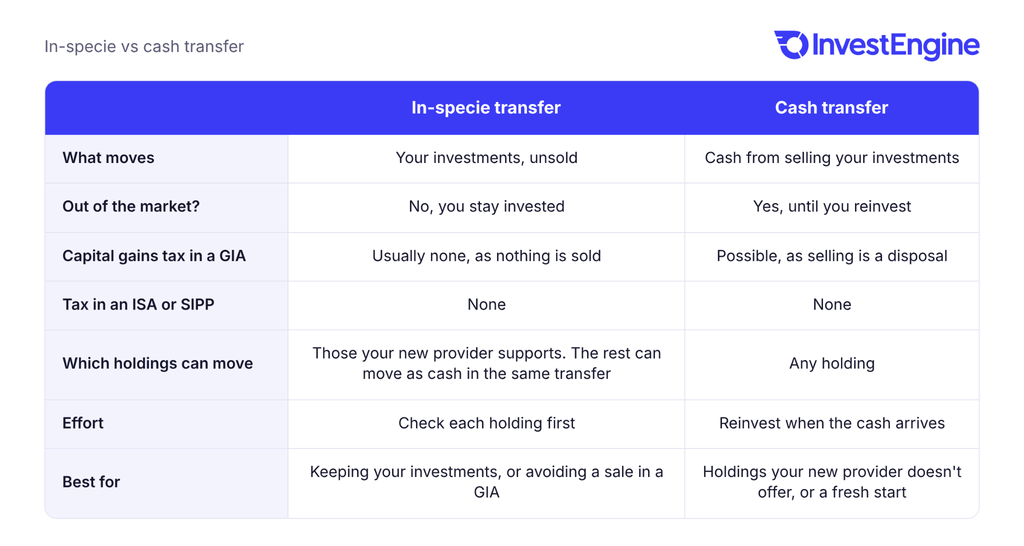
An in-specie transfer doesn’t have to be all or nothing. It can include a cash element too. In the same transfer, you can usually:
- Move cash you already hold in the account.
- Sell fractional holdings, meaning part units or part shares, and move them as cash.
- Sell holdings your new provider doesn’t offer, and move them as cash.
Any holdings your new provider does support can still move in specie alongside the cash. So you don’t need every investment to be accepted to use an in-specie transfer.
Do you pay tax when you transfer?
You don’t pay tax when you transfer an ISA or SIPP, whether you move it in specie or as cash.
In a GIA (general investment account), a cash transfer means selling, which can create a capital gains tax (CGT) bill. However, an in-specie GIA transfer won’t trigger a sale and therefore a potential CGT bill.
ISA and SIPP transfers. An ISA (individual savings account) and a SIPP (self-invested personal pension) keep their tax benefits when you move them to a new provider through a proper transfer. Selling inside the account to move as cash doesn’t trigger capital gains tax.
GIA transfers. Selling investments in a GIA is a disposal for capital gains tax. If your gains for the tax year are above the £3,000 annual exempt amount in 2026/27, you may pay tax at 18% or 24%, depending on your income.
An in-specie GIA transfer is usually a change of provider rather than a sale. HMRC says a transfer of legal ownership between a nominee and the beneficial owner is not a disposal. The gain doesn’t disappear, though. It stays with your investments until you sell them.
Read our guide to GIA and capital gains tax to find out more.
Does transferring an ISA use up your ISA allowance?
No. Transferring an ISA to a new provider doesn’t use up any of your £20,000 ISA allowance for 2026/27.
However, this only works if you use a proper ISA transfer. If you withdraw the money yourself and pay it into a new ISA, it counts as a new payment and uses up this year’s allowance.
Always ask your new provider to arrange the transfer, and don’t withdraw the money first.
How long does a transfer take?
A transfer between two cash ISAs should take no longer than 15 working days. If either ISA is a Stocks and Shares ISA, the transfer should take no longer than 30 calendar days. Pension and GIA transfers don’t have the same set timescales.
As a rough guide, here’s how long transfers often take:
- Cash ISA to cash ISA: up to 15 working days, often less.
- Any transfer involving a Stocks and Shares ISA: up to 30 calendar days, whether it moves as cash or in specie. Many finish sooner.
- SIPP transfers: usually around four to six weeks.
- GIA transfers: often a few weeks, depending on your old provider.
The biggest factor is usually how your old provider handles transfers, not whether you move cash or investments. Providers that use standard electronic transfer systems tend to be much quicker. Providers that still use email, post or fax tend to be slower, even for a simple cash transfer.
In-specie transfers also need time to settle. Once the providers have agreed the transfer, it usually takes about two working days for the investments to move across.
These are estimates, not guarantees. Transfers can also take longer if your details don’t match, or a pension provider needs extra checks before releasing your money.
Which investments can transfer in specie?
An investment can transfer in specie only if your new provider offers exactly the same one. It doesn’t matter whether it’s an ETF, a share or a fund. If your new provider doesn’t offer it, it usually has to be sold and moved as cash.
‘Exactly the same’ means the same version of the investment, identified by its ISIN (a unique code for each investment). If your new provider offers a similar fund but not the same version, your holding can’t move in specie.
Fractional holdings, meaning part units or part shares, often have to be sold and moved as cash too. This applies even if the rest of the holding moves in specie.
For example, say your ISA holds three investments. If your new provider offers two of them, those two can move in specie and the third would be sold and moved as cash, all in the same transfer.
Your new provider isn’t obliged to accept every holding, or every transfer. Your old provider may also charge exit fees, dealing fees for selling, or fees for re-registering holdings.
Worked example: in-specie vs cash on a £30,000 GIA
An in-specie transfer can avoid a capital gains tax bill when you move a GIA with gains, because nothing is sold. These two examples show the same GIA moved in two different ways in 2026/27.
Sam and Aisha each have a GIA worth £30,000. They each paid £20,000 for their investments, so each has a gain of £10,000. Neither has made any other gains this tax year.
Sam moves his GIA as cash
Sam’s old provider sells his investments, so he makes a gain of £10,000. After the £3,000 annual exempt amount, £7,000 is taxable.
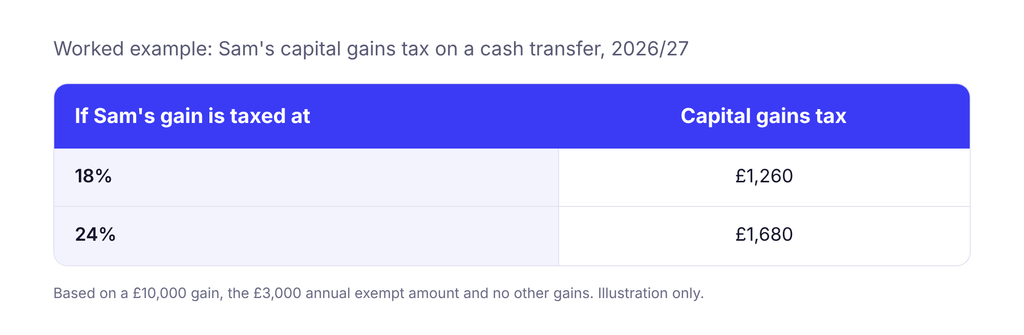
Sam is also out of the market until he reinvests the cash with his new provider.
Aisha moves her GIA in specie
Aisha’s investments move to her new provider without being sold. She doesn’t make a disposal, so there’s no capital gains tax to pay on the transfer. Her investments keep their original cost of £20,000, so the £10,000 gain is still there and may be taxed when she sells in the future.
This is an illustration, not a forecast. It assumes Sam invests in different holdings, as buying back the same investments within 30 days changes how the gain is worked out. The value of investments can fall as well as rise.
What are the risks of each method?
Both methods carry risks. With an in-specie transfer, the main risk is that not everything can move. With a cash transfer, the main risk is being out of the market for a short time.
In-specie transfer risks
- Some holdings can’t move. Anything your new provider doesn’t offer will need to be sold.
- Part in specie, part cash. You may end up with some of your account moved in specie and some as cash.
- Not every provider can do it. Some providers can’t process in-specie transfers, depending on the systems they use.
- Fees. Your old provider may charge to re-register holdings.
Cash transfer risks
- Out of the market. You won’t benefit from any rises while your money is in cash, though you could also avoid falls. This window is usually shorter than people expect. Most of the transfer, such as checking your identity, agreeing amounts and completing paperwork, happens while you’re still invested. Your investments are usually sold near the end, and the money is normally sent to your new provider soon after the sale settles. Deciding in advance how you’ll reinvest, and doing it as soon as the cash arrives, keeps the gap short.
- Capital gains tax in a GIA. Selling can create a gain, which may be taxable above £3,000.
- Dealing costs. Your old provider may charge to sell your investments.
Which should you choose?
The right method depends on what you hold, which account it’s in and whether your new provider offers the same investments. These scenarios show which method often suits which situation.
- Your holdings are all available with your new provider. An in-specie transfer lets you stay invested.
- You have large gains in a GIA. An in-specie transfer can avoid a sale and a capital gains tax bill now.
- Your new provider doesn’t offer your holdings. A cash transfer is usually the only option for those holdings.
- You want to change your investments anyway. A cash transfer can be simpler, especially in an ISA or SIPP, where selling is tax-free.
- Your account is mostly cash already. A cash transfer is usually simpler.
- You have a mix of holdings. An in-specie transfer can move what your new provider supports and sell the rest, in the same transfer.
If you’re unsure, ask your new provider which of your holdings it can accept before you start.
What can and cannot be transferred to InvestEngine?
InvestEngine accepts transfers of ISAs, SIPPs and GIAs from other providers. InvestEngine doesn’t charge to transfer in, but your old provider may charge exit fees, dealing fees or re-registration fees.
ISAs. InvestEngine offers a Stocks and Shares ISA, not a cash ISA. You can transfer a Stocks and Shares ISA from another provider, or move a cash ISA into an InvestEngine Stocks and Shares ISA, where the money can be invested. ETFs available on InvestEngine can move in specie into a DIY portfolio when you transfer your whole ISA. You can also transfer part of the money you paid in during previous tax years, but partial transfers are made as cash.
SIPPs. You can transfer a SIPP or personal pension from most major pension providers, and ETFs available on InvestEngine can move in specie. The InvestEngine SIPP only accepts personal contributions, so it may not suit a workplace pension your employer still pays into.
GIAs. You can transfer a GIA from another provider to InvestEngine, either in specie or as cash. To start a GIA transfer, contact our customer support team, who will set it up for you. ETFs available on InvestEngine can move in specie, so they aren’t sold and won’t trigger capital gains tax. Any holdings we don’t offer will need to be sold and moved as cash, and selling in a GIA could mean a capital gains tax bill.
In-specie transfers also depend on your old provider. Some providers can’t send investments in specie to InvestEngine because of the systems they use to handle transfers. If that’s the case, your transfer can still be made as cash.
What InvestEngine can’t accept:
- Junior ISAs
- Junior SIPPs
- SIPPs in drawdown
- Pensions with a pension sharing or earmarking order
- Holdings other than ETFs available on InvestEngine, which are sold and moved as cash
How do you transfer step by step?
You transfer an account by asking your new provider to arrange it. Your new provider then contacts your old one, so you don’t need to close anything yourself.
- Open an account with your new provider. Make sure it’s the same type of account you want to move, such as a Stocks and Shares ISA or SIPP.
- Request the transfer from your new provider. Choose in specie or cash, and tell them whether you’re moving all or part of the account.
- Your new provider contacts your old one. They arrange the transfer between them. Your investments usually stay invested while this happens.
- Your holdings or cash arrive. In-specie holdings appear as they were. Cash arrives ready to invest.
- Check and invest. Check everything has arrived, then invest any cash.
If you want to transfer, don’t just close your old account or withdraw the money yourself first. For an ISA, that would use up your allowance. For a pension, it could mean a large tax bill.
Frequently asked questions
What does in-specie mean?
In specie is Latin for ‘in the form’. An in-specie transfer moves your investments to a new provider in the form they’re already in, without selling them. Your holdings are re-registered with the new provider, so you keep the same investments and stay invested while the transfer goes through. It’s sometimes called a re-registration.
Is an in-specie transfer better than a cash transfer?
Neither is better for everyone. An in-specie transfer keeps you invested and can avoid capital gains tax in a GIA, but only holdings your new provider offers can move. A cash transfer works for any holding but leaves you out of the market until you reinvest. The right choice depends on what you hold.
Do I pay tax on an in-specie transfer?
An in-specie transfer of an ISA or SIPP doesn’t create a tax bill. An in-specie GIA transfer is usually a change of provider rather than a sale, so it doesn’t normally trigger capital gains tax. Any gain stays with your investments and may be taxed when you sell. Tax rules depend on your circumstances and can change.
Will I lose my ISA allowance if I transfer?
No. A proper ISA transfer doesn’t use any of your £20,000 ISA allowance for 2026/27, and your money keeps its tax-free status. The important thing is not to withdraw the money yourself. If you take money out and pay it into a new ISA, it counts as a new payment and uses up this year’s allowance.
How long does an ISA transfer take?
A transfer between two cash ISAs should take no longer than 15 working days. If either ISA is a Stocks and Shares ISA, it should take no longer than 30 calendar days, whether it moves as cash or in specie. Providers with electronic transfer systems are often quicker. Your new provider can tell you what to expect.
Can I transfer part of my ISA?
Yes. GOV.UK says you can transfer all or part of an ISA to another provider at any time. This includes money paid in during the current tax year or earlier years. Some providers ask for current-year money to be moved in full, and some only move partial transfers as cash, so check first.
Can I transfer my pension in specie?
Yes, if both providers allow it. HMRC says pension transfers can be made in cash, in specie or as a mix. Only holdings your new provider offers can move in specie, and the rest are usually sold. Check for exit fees and any valuable guarantees before you transfer, and consider regulated advice.
What happens to my investments during a transfer?
Your investments usually stay invested for most of the transfer, while the providers check details and agree amounts. In an in-specie transfer, they’re never sold. In a cash transfer, they’re usually sold near the end and the money is sent on soon after, so you’re out of the market only until you reinvest.
What to do next
- Check your holdings and any exit fees. Find out which of your investments your new provider offers, and what your old provider charges to leave.
- Decide on in specie or cash. Think about tax, how long you’d be out of the market and whether you want to keep your current investments.
- Start the transfer with your new provider. Don’t close your old account or withdraw the money yourself.
Important information
Capital at risk. The value of your investments can go down as well as up and you may get back less than you invest. Past performance is not a reliable guide to future returns. ETFs carry costs, and their value can fall as well as rise. Tax treatment depends on your individual circumstances and may change in the future.
Pension transfers can involve giving up valuable benefits, such as guaranteed annuity rates or a protected pension age. Check with your current provider before you transfer, and consider speaking to a regulated financial adviser. You may need advice if your pension includes guaranteed benefits worth more than £30,000. This is general information, not personalised advice.