


Summary
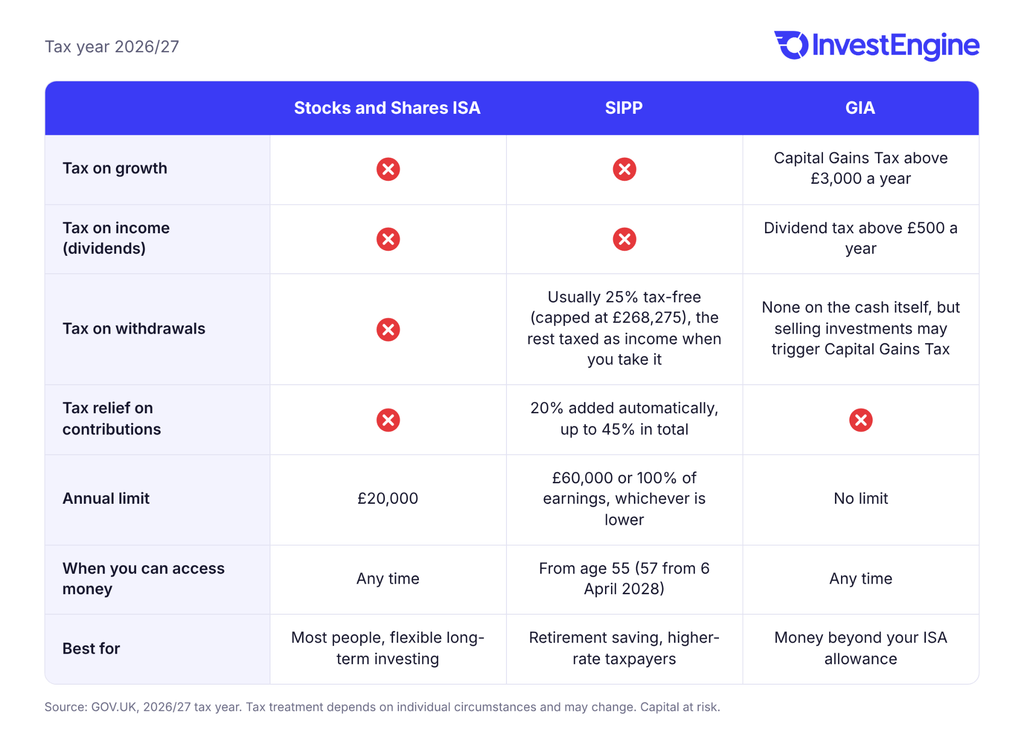
The right account usually depends on when you might need your money back. A Stocks and Shares ISA is a common starting point because you can put away up to £20,000 for the 2026/27 tax year, while paying no income or capital gains tax on growth, and being able to take your money out whenever you want. A SIPP (self-invested personal pension) adds tax relief on your personal contributions at your income tax rate, but locks your money away until age 55 (57 from April 2028). A GIA (general investment account) makes sense to hold anything beyond your ISA allowance.
ISA vs SIPP vs GIA: a quick comparison (2026/27)
What is a Stocks and Shares ISA?
A Stocks and Shares ISA (individual savings account) is a tax-free wrapper for investments such as ETFs, funds and shares. In the 2026/27 tax year, you can pay in up to £20,000, and you pay no income tax, capital gains tax or dividend tax on anything inside it.
Who a Stocks and Shares ISA suits
Almost everyone. It is the natural starting point for first-time investors, people saving for medium or long-term goals, and anyone who wants to keep access to their money.
Key benefit
Tax-free growth and tax-free withdrawals, at any time. You never need to report ISA gains or income on a tax return.
Key limits:
- The £20,000 annual ISA allowance is shared across all your ISAs (Cash, Stocks and Shares, Lifetime and Innovative Finance). Unused allowance does not carry over to the next tax year.
- There is no upfront tax relief. You pay in from money you have already paid tax on.
- From 6 April 2027, under-65s will only be able to put £12,000 of their £20,000 allowance into cash ISAs. The overall £20,000 limit stays the same. Interest on cash held inside a Stocks and Shares ISA will also be taxed at a flat 22% from that date.
How a Stocks and Shares ISA works with ETFs
An ETF (exchange-traded fund) is a low-cost fund that tracks a market, such as the FTSE 100 or global shares. Inside an ISA, any gains and dividends from your ETFs are tax-free. With InvestEngine, you can build your own ETF portfolio in an ISA.
Worked example
Sam invests £10,000 in a global ETF. Over several years it grows to £15,000, a £5,000 gain. In an ISA, Sam pays no tax when selling. In a GIA, £2,000 of that gain would sit above the £3,000 capital gains tax allowance, costing £360 at the 18% basic rate or £480 at the 24% higher rate. This is just an illustration as an example only, not a forecast.
What is a SIPP?
A SIPP (self-invested personal pension) is a personal pension where you choose the investments, and the government tops up what you pay in with tax relief. For every £80 you pay into a SIPP, £20 of basic-rate tax relief is added, making £100.
How SIPP tax relief works:
- Basic rate (20%): your SIPP provider claims it from HMRC and adds it to your pot automatically.
- Higher rate (40%): you can claim an extra 20% back through your Self Assessment tax return, on contributions up to the amount of income you paid 40% tax on.
- Additional rate (45%): you can claim an extra 25% back the same way.
- Scottish taxpayers have different bands and claim different amounts.
Who a SIPP suits
Anyone saving for retirement, and especially higher-rate taxpayers, the self-employed and company directors. A SIPP can also sit alongside a workplace pension.
Key benefit
Upfront tax relief of 20% to 45%, plus tax-free growth. When you access your pension, you can usually take 25% of your pension tax-free, up to a lump sum allowance of £268,275. The rest is taxed as income when you take it.
Key limits:
- Access age: a SIPP is locked until the normal minimum pension age, currently 55. This rises to 57 on 6 April 2028.
- Annual allowance: you can get tax relief on contributions up to £60,000 a year in 2026/27, or 100% of your UK earnings if lower. If you have no earnings, you can still pay in £2,880 a year and get it topped up to £3,600.
- Tapered annual allowance: if your threshold income is over £200,000 and your adjusted income is over £260,000, your allowance shrinks, down to a minimum of £10,000.
- Unused allowance: you may be able to carry forward unused annual allowance from the previous three tax years.
- Inheritance Tax: from 6 April 2027, most unused pension funds and death benefits will count as part of your estate for Inheritance Tax. Anything left to a spouse or civil partner is usually exempt.
How a SIPP works with ETFs
You can hold the same low-cost ETFs in a SIPP as in an ISA. With the InvestEngine SIPP, you can build your own ETF portfolio, so a SIPP does not mean giving up control.
Worked example
Priya pays £8,000 into her SIPP. Her provider adds £2,000 of basic-rate relief, so £10,000 is invested. As a higher-rate taxpayer, Priya claims another £2,000 back through Self Assessment. Her real cost for £10,000 in her pension is £6,000. An additional-rate taxpayer would claim £2,500 back, for a real cost of £5,500.
What is a GIA?
A GIA (general investment account) is a standard investment account with no tax wrapper and no annual limit. A GIA is for money you want to invest after you have used your ISA allowance, because gains and income in a GIA can be taxed.
Who a GIA suits
Investors who have already used their £20,000 ISA allowance for the year, or who want to invest a lump sum larger than £20,000.
Key benefit
No limit on how much you pay in, and you can withdraw at any time.
Key limits
A GIA has no tax shelter. In 2026/27:
- Capital gains tax: gains above the £3,000 annual exempt amount are taxed at 18% for basic-rate taxpayers and 24% for higher and additional-rate taxpayers.
- Dividend tax: dividends above the £500 dividend allowance are taxed at 10.75% (basic rate), 35.75% (higher rate) or 39.35% (additional rate).
- Interest: some bond ETFs pay out interest rather than dividends. This is taxed as savings income once you go over your Personal Savings Allowance.
- Paperwork: you may need to report gains and income on a Self Assessment tax return.
How a GIA works with ETFs
You can hold the same ETFs in a GIA as in an ISA or SIPP. Many investors use a GIA as an overflow, then move money into their ISA each new tax year. This is often called ‘Bed and ISA’: selling investments in a GIA and buying them back inside an ISA. Selling can trigger capital gains tax, so check your gains first.
Worked example
Tom holds £50,000 of ETFs in a GIA that pay a 2% dividend yield, or £1,000 a year. The first £500 is covered by his dividend allowance. As a higher-rate taxpayer, he pays 35.75% on the other £500, which is £178.75 a year. In an ISA or SIPP, the tax would be £0.
Which account should you open?
The right account depends on two things: when you might need your money back, and how much tax relief you can get. Find the situation that sounds most like you.
If you might need the money before retirement
A Stocks and Shares ISA is the natural home for money you may want back before retirement. You can withdraw at any time without penalty, and everything inside it is free from UK income and capital gains tax. The trade-off is that there’s no upfront tax relief, unlike a SIPP.
- Want access at any time? Consider a Stocks and Shares ISA. You pay no income tax on dividends or interest and no capital gains tax on growth. You can pay in up to £20,000 in the 2026/27 tax year.
- Investing for five years or more? A Stocks and Shares ISA can suit medium and long-term goals. That could be a house deposit, your children’s future, or building wealth alongside your pension. The longer you invest, the more time your money has to recover from any falls.
- Need the money within a few years? Think carefully before investing. Investments can fall as well as rise, and a drop just before you need the cash could leave you with less than you put in. For short-term goals, cash may be the better fit.
- Haven’t got an emergency fund yet? Build one first. Keeping some easy-access cash for unexpected bills means you’re less likely to have to sell investments at a bad time.
- Saving as a couple? You each get your own allowance. Each adult has a separate £20,000 ISA allowance, so a couple can shelter up to £40,000 a year between them.
The key trade-off: an ISA gives you flexibility but no tax relief on what you pay in. If you’re saving for retirement and pay higher-rate tax, a SIPP may give you more for the same money, and many people use both.
If you’re saving for retirement
A SIPP (self-invested personal pension) is built for retirement saving. The main draw is tax relief: the government tops up what you pay in, so more of your money goes to work from the start. The trade-off is that you can’t usually access it until age 55, rising to 57 from April 2028.
- Have a workplace pension? Make sure you’re getting the full employer match first. If your employer matches your contributions, that’s extra money you’d otherwise miss out on. A SIPP can sit alongside a workplace pension for anything you want to save on top, or if you’d like more control over your investments.
- Building your own pension? Consider a SIPP. For every £80 you pay in, your SIPP provider claims £20 of basic-rate tax relief from HMRC and adds it to your pot, making £100. You can usually take 25% tax-free when you access your pension, up to £268,275, with the rest taxed as income when you take it.
- Pay higher or additional-rate tax? Consider a SIPP alongside your ISA. Basic-rate relief is added automatically. You can then claim back an extra 20% (higher rate) or 25% (additional rate) through your Self Assessment tax return. For a higher-rate taxpayer, a £10,000 pension contribution can cost as little as £6,000. Scottish taxpayers have different rates.
- Adjusted net income between £100,000 and £125,140? A SIPP can be especially valuable. Your £12,570 Personal Allowance falls by £1 for every £2 of adjusted net income over £100,000. Pension contributions reduce your adjusted net income, so they can help you win that allowance back, which makes the effective tax relief on that slice of income 60%.
- Self-employed? Consider a SIPP. Without a workplace pension, a SIPP is a simple way to get pension tax relief. You get relief on personal contributions up to 100% of your relevant UK earnings in the tax year, within the £60,000 annual allowance.
- Company director? Check how you pay yourself. Tax relief on personal contributions is limited to your relevant UK earnings, such as salary. Dividends don’t count, so a director on a low salary may only get relief on a small amount. The InvestEngine SIPP currently accepts personal contributions only, so your company can’t pay in directly.
- No earnings? You can still benefit. You can pay in up to £2,880 a year and have it topped up to £3,600 with basic-rate tax relief, as long as you’re under 75.
The key trade-off: money in a SIPP is locked away until 55 (57 from April 2028). If there’s a chance you’ll need it sooner, an ISA keeps your options open, and many people use both.
If you’ve used your ISA allowance
- Already put in £20,000 this tax year? Consider a GIA. There’s no limit on what you can invest, though gains over £3,000 and dividends over £500 a year may be taxed.
Still not sure? Most people start with a Stocks and Shares ISA, add a SIPP once retirement saving matters, and use a GIA only when their ISA allowance is full.
Can you have an ISA, a SIPP and a GIA at the same time?
Yes. You can hold a Stocks and Shares ISA, a SIPP and a GIA at the same time, and many investors do. Each account has its own rules, so using all three lets you balance tax relief, tax-free growth and access to your money.
The ISA and SIPP allowances are separate. In 2026/27, you could put £20,000 into ISAs and up to £60,000 into pensions, with any extra going into a GIA.
In what order should you fill them?
For lots of investors, a logical order might be the ISA first, SIPP second, and then GIA third.
However, if your employer matches workplace pension contributions, make sure you get the full match before anything else, because it’s extra money you would otherwise miss.
- Stocks and Shares ISA. Use as much of your £20,000 ISA allowance as you can afford. ISA money stays flexible and tax-free.
- SIPP. Add pension contributions for retirement and claim the tax relief. Higher and additional-rate taxpayers may want to put the SIPP on equal footing with the ISA, because the relief is worth 40% to 45%.
- GIA. Use a GIA only for money left over once your ISA allowance is full and you’re happy with your pension contributions.
ISA vs SIPP for high earners
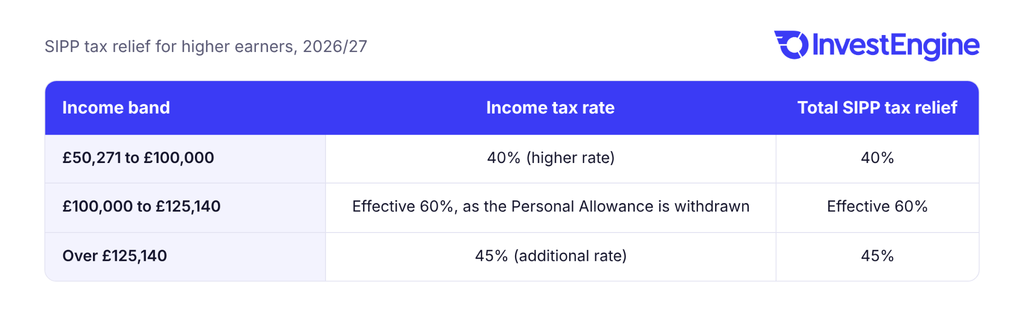
For high earners, a SIPP often becomes as important as an ISA, because pension contributions can cut your tax bill at 40%, 45% or even an effective 60%. The ISA still matters for money you may need before retirement.
If you’re a high earner, these 2026/27 thresholds matter (England, Wales and Northern Ireland):
The £100,000 tax trap: what you need to know
If your adjusted net income is between £100,000 and £125,140, you pay an effective 60% tax rate on that slice of income. This is because your £12,570 Personal Allowance falls by £1 for every £2 you earn over £100,000, and disappears completely at £125,140.
Pension contributions reduce your adjusted net income and can help bring you back below £100,000, restore your Personal Allowance and give you an effective 60% tax relief on that part of your income.
Worked example: how a pension contribution can get 60% tax relief
Alex earns £110,000 a year. Because Alex earns £10,000 over the £100,000 threshold, they lose £5,000 of their £12,570 Personal Allowance (£1 for every £2 over).
Alex decides to pay £8,000 into a SIPP. Here’s what happens:
- Alex’s SIPP provider adds £2,000 of basic-rate tax relief. Alex’s £8,000 becomes £10,000 in the pension. Saving so far: £2,000.
- Alex claims higher-rate relief through Self Assessment. As a higher-rate taxpayer, Alex can claim back a further 20% of the £10,000. Extra saving: £2,000.
- Alex gets their full Personal Allowance back. The £10,000 contribution brings Alex’s adjusted net income down from £110,000 to £100,000, so the £5,000 of Personal Allowance is restored. That £5,000 is no longer taxed at 40%. Extra saving: £2,000.
The result: Alex has £10,000 in their pension, and their tax bill falls by £4,000. After the £2,000 their provider added, the real cost to Alex is £8,000 minus £4,000, which is £4,000. That’s tax relief of 60% on the money in this income band.
This example assumes Alex lives in England, Wales or Northern Ireland, all their income is from employment, and they make no other pension contributions. It’s an illustration, not a forecast.
Pension contributions also reduce your adjusted net income which can help you keep Child Benefit (tapered away between £60,000 and £80,000), and Tax-Free Childcare and funded childcare hours (lost if either parent’s adjusted net income is over £100,000).
If you have a workplace pension, salary sacrifice may save National Insurance too. Talk to your employer, and consider financial advice if your situation is complex.
Can you transfer an existing ISA or SIPP?
Yes. You can transfer an existing ISA to InvestEngine from most UK providers, and it keeps its tax-free status.
- ISA transfers: always use the transfer process rather than withdrawing the money yourself. A transfer keeps your money inside the ISA wrapper and doesn’t use up your £20,000 allowance. If you withdraw it instead, it leaves the tax-free wrapper, and paying it back in usually counts towards this year’s allowance, unless your ISA is flexible and you pay it back into the same ISA in the same tax year.
- SIPP transfers: InvestEngine accepts SIPP transfers from most major providers. However, before you transfer a pension make sure you check for exit fees and any valuable benefits, such as guaranteed annuity rates or a protected tax-free cash amount, that you could lose.
Frequently asked questions
Should I open an ISA or a SIPP first?
Lots of people will choose to open a Stocks and Shares ISA first, because ISA money is tax-free and accessible at any time. A SIPP is usually better for retirement saving, as it adds tax relief of 20% to 45% but locks money until age 55, rising to 57 in April 2028. Many investors use both.
What is the difference between a SIPP and a GIA?
A SIPP is a pension with tax relief on contributions and tax-free growth, but you cannot access it until age 55 (57 from April 2028). A GIA has no tax relief or tax shelter, so gains above £3,000 and dividends above £500 a year may be taxed, but you can withdraw at any time.
Can I have an ISA, a SIPP and a GIA at the same time?
Yes. You can hold a Stocks and Shares ISA, a SIPP and a GIA at the same time. The allowances are separate: in 2026/27 you can pay £20,000 into ISAs and up to £60,000 into pensions. A GIA has no limit and is usually used for money beyond those allowances.
What is the ISA allowance for 2026/27?
The ISA allowance for the 2026/27 tax year is £20,000. You can split it across Cash, Stocks and Shares, Lifetime and Innovative Finance ISAs. From 6 April 2027, under-65s can put a maximum of £12,000 into cash ISAs, but the overall £20,000 ISA allowance stays the same.
How does SIPP tax relief work?
SIPP tax relief adds 20% to your contributions automatically, so a £80 payment becomes £100. Higher-rate taxpayers can claim an extra 20%, and additional-rate taxpayers an extra 25%, through Self Assessment. Relief applies on contributions up to 100% of your UK earnings or the £60,000 annual allowance in 2026/27, whichever is lower. If you earn less than £3,600, you can still get relief on up to £3,600 gross.
When can I access money in a SIPP?
You can access money in a SIPP from age 55, the current normal minimum pension age. This rises to 57 on 6 April 2028. You can usually take 25% tax-free, up to a £268,275 lump sum allowance, with the rest taxed as income when you withdraw it.
How are gains and dividends taxed in a GIA?
In a GIA in 2026/27, capital gains above the £3,000 annual exempt amount are taxed at 18% or 24%, depending on your income. Dividends above the £500 dividend allowance are taxed at 10.75%, 35.75% or 39.35%. Gains and dividends in an ISA or SIPP are not taxed.
Is an ISA or a SIPP better for ETFs?
An ISA and a SIPP are both good homes for ETFs, because neither charges tax on ETF gains or dividends. On InvestEngine, you can build your own ETF portfolio in either account.
Your next step
The best account is the one that matches when you will need your money.
Here’s where to start.
- Want flexibility and tax-free growth?
Open an InvestEngine Stocks and Shares ISA and use your 2026/27 allowance before 5 April 2027. - Saving for retirement or paying higher-rate tax?
Open an InvestEngine SIPP and let tax relief do some of the work. - Already used your ISA allowance?
Open an InvestEngine GIA for the extra, and move money into your ISA each new tax year.
If you are unsure which account suits your circumstances, speak to a regulated financial adviser.
Important information
Capital at risk. The value of your investments can go down as well as up and you may get back less than you invest. Tax treatment depends on your individual circumstances and may change in the future. ETFs carry costs and their value can fall as well as rise. Pension money is generally not accessible until age 55, rising to 57 from 6 April 2028. This is not personalised advice.