


Summary
Once you’ve used your £20,000 ISA allowance, a GIA (general investment account) lets you keep investing with no upper limit. The trade-off is tax. In 2026/27, gains above the £3,000 annual exempt amount and dividends above the £500 dividend allowance can be taxed. A few simple habits, used each year, can keep that tax bill down.
What happens when your ISA is full?
When your ISA is full, you can keep investing in a GIA, pay into a pension such as a Self-Invested Personal Pension (SIPP), or wait for your ISA allowance to reset on 6 April. Lots of people who want to keep investing now use a GIA for the extra money.
The ISA allowance is £20,000 for the 2026/27 tax year. It resets every 6 April, and any allowance you don’t use is lost. You can’t carry it forward.
Once you’ve used it, you usually have three main options:
- Open a GIA. A GIA has no annual limit and no restrictions on when you take money out, but gains and income can be taxed.
- Pay into a SIPP. A SIPP (self-invested personal pension) adds tax relief to what you pay in, up to your annual allowance, but you usually can’t access it until age 55, rising to 57 from 6 April 2028.
Our guide to ISA vs SIPP vs GIA: which account should you open? explains the trade-offs. - Wait for the new tax year. If you can hold cash until 6 April, you can invest it in your ISA with a fresh £20,000 allowance.
What is capital gains tax on a GIA?
Capital gains tax (CGT) is a tax on the profit you make when you sell an investment for more than you paid for it. In a GIA, you only pay CGT when you sell at a profit, and you pay it on the gain, not on the full amount you sell.
That profit is called a ‘gain’. If you buy an exchange-traded fund (ETF) for £10,000 and later sell it for £14,000, your gain is £4,000. CGT is worked out on that £4,000, not on the £14,000.
You don’t pay CGT while your investments are rising in value. You only pay it when you sell, or otherwise ‘dispose’ of them. You don’t pay CGT on investments held in an ISA or SIPP.
What are the capital gains tax rates and allowance in 2026/27?
In the 2026/27 tax year, the first £3,000 of your total gains is tax-free. Gains above that are taxed at 18% or 24%, depending on your income.
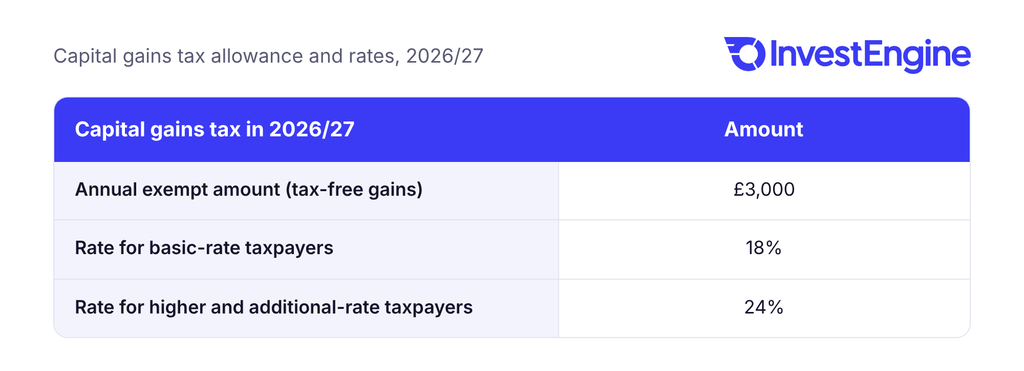
For basic-rate taxpayers, the rate depends on how much of the £37,700 basic rate band your taxable income has already used. Your taxable gains are added on top of your taxable income: any part that still fits within the basic rate band is taxed at 18%, and anything above it is taxed at 24%.
How is tax on GIA dividends and interest different?
Dividends and interest from investments in a GIA are taxed as income, not as capital gains. You pay this tax each year as the income is paid, whether or not you sell anything.
Dividends. The first £500 of dividends each year is tax-free under the dividend allowance. Above that, the dividend tax rates for 2026/27 are:
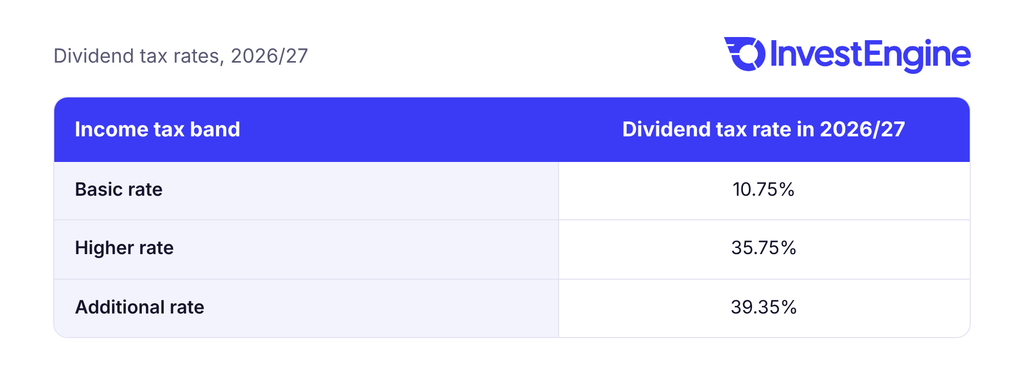
The basic and higher rates both rose by 2 percentage points on 6 April 2026, from 8.75% and 33.75%. That makes the ISA allowance more valuable for income-paying investments than it was a year ago.
Interest. Some bond ETFs pay out interest rather than dividends. This is taxed as savings income once you go over your Personal Savings Allowance, which is £1,000 for basic-rate taxpayers, £500 for higher-rate taxpayers and £0 for additional-rate taxpayers.
Accumulating ETFs. If you hold accumulating ETFs, which reinvest income rather than paying it out, you may still owe tax on that income in a GIA, even though you don’t receive it as cash.
How does capital gains tax work with ETFs?
Capital gains tax on ETFs works much like it does on shares. When you sell ETF units in a GIA, your gain is the sale price minus your average purchase cost, and you only pay tax if your total gains for the year are above £3,000.
Average cost. If you buy the same ETF several times, HMRC treats all those units as one pool. Each unit is given the same average cost. So if you bought 100 units at £10 and 100 units at £12, your average cost is £11 a unit.
Gains and losses. If you sell for less than your average cost, you make a loss. Losses can be used to reduce your gains, as explained below.
UK reporting status. Many ETFs sold in the UK are based overseas, often in Ireland or Luxembourg. If an ETF has UK ‘reporting fund’ status, your gains are taxed as capital gains at 18% or 24%. If it doesn’t, gains are usually taxed as income at your higher income tax rate instead. Most ETFs aimed at UK investors have reporting status, but you can check on HMRC’s list of reporting funds.
Worked example: how much tax would you pay on a GIA gain?
These two examples show how the £3,000 annual exempt amount and the CGT rates work in 2026/27. Both assume the person lives in England, Wales or Northern Ireland, their only income is salary, and they have no other gains or losses that year.
Example 1: Hannah, a basic-rate taxpayer
Hannah earns £42,570, so her taxable income after her £12,570 Personal Allowance is £30,000. That leaves £7,700 of her £37,700 basic rate band unused. She sells ETFs in her GIA and makes a gain of £13,000.
- Gain: £13,000
- Minus the £3,000 annual exempt amount: £10,000 taxable gain
- The first £7,700 fits in her remaining basic rate band, taxed at 18%: £1,386
- The remaining £2,300 is taxed at 24%: £552
- Total CGT: £1,938
Example 2: Lisa, a higher-rate taxpayer
Lisa earns £90,000, so she’s a higher-rate taxpayer. She also makes a gain of £13,000 in her GIA.
- Gain: £13,000
- Minus the £3,000 annual exempt amount: £10,000 taxable gain
- All of it is taxed at 24%: £2,400
If both had held the same ETFs in an ISA, they would pay no CGT at all.
These examples are illustrations, not forecasts. The value of investments can fall as well as rise. Tax treatment depends on your individual circumstances and may change in the future.
How can you reduce capital gains tax on a GIA?
You can often reduce capital gains tax on a GIA by planning when and how you sell. These are some of the most common ways to do it:
- Use your £3,000 annual exempt amount every year. The allowance can’t be carried forward. Selling enough each year to realise up to £3,000 of gains can stop large gains building up.
- Move money into your ISA each tax year with ‘Bed and ISA’. This means selling investments in your GIA and buying them back inside your ISA, using your new £20,000 allowance. The sale can trigger CGT, so check your gains first.
- Use transfers between spouses or civil partners. You can give assets to your spouse or civil partner without paying CGT. When they sell, their gain is worked out from what you originally paid, but they can use their own £3,000 allowance and possibly a lower tax rate.
- Use losses to offset gains. Losses made in the same tax year reduce your gains. Unused losses can be carried forward, but you must report them to HMRC within four years of the end of the tax year you made them.
- Pay into a SIPP. Personal contributions to a SIPP extend your basic rate band by the gross amount you pay in. For a basic-rate taxpayer, this can mean more of a gain is taxed at 18% instead of 24%.
- Spread sales across tax years. Selling part of a holding before 5 April and the rest after 6 April gives you two £3,000 allowances, and may keep more of the gain within your basic rate band.
In Hannah’s example, a gross SIPP contribution of £2,300 (£1,840 from her, plus £460 tax relief) would extend her basic rate band enough for her whole £10,000 taxable gain to be taxed at 18%. That would cut her CGT from £1,938 to £1,800.
What is the 30-day rule?
The 30-day rule stops you selling an investment and buying it straight back in the same account just to use your CGT allowance. If you rebuy the same investment within 30 days in a GIA, HMRC matches the sale with the new purchase, not with your original cost.
HMRC matches sales in this order:
- Units bought on the same day as the sale (the ‘same day’ rule)
- Units bought in the 30 days after the sale (the ‘30-day’ or ‘bed and breakfast’ rule)
- Units you already held, at their average cost
Bed and ISA doesn’t run into this problem. Investments held in an ISA are treated as held separately from your other investments, so buying the same ETF back inside your ISA isn’t matched with the sale in your GIA.
Do you need to report GIA gains to HMRC?
You need to report GIA gains to HMRC if your total gains in the tax year are above the £3,000 annual exempt amount. You may also need to report if the total value of what you sold was more than £50,000, even if you have no tax to pay.
You can report gains on a Self Assessment tax return, or through HMRC’s real time Capital Gains Tax service if you’re eligible. You’ll need the purchase and sale prices, dates and any costs for each investment you sold.
Gains, dividends and interest in an ISA don’t need to be reported to HMRC.
When does a GIA still make sense?
A GIA makes sense when you have money to invest beyond your ISA allowance and want to keep it accessible. For many investors, especially higher earners, it’s a useful extra account rather than a first choice.
A GIA can suit you if:
- Your ISA is full. You’ve used your £20,000 ISA allowance and want to keep investing this tax year.
- You have a lump sum over £20,000. You can invest the rest in a GIA now and move some into your ISA each new tax year.
- You want access at any time. Unlike a SIPP, there’s no minimum age for withdrawals.
- You want no contribution cap. A GIA has no annual limit on how much you can pay in.
How do you use a GIA with InvestEngine?
An InvestEngine GIA gives you access to the same range of ETFs as our ISA and SIPP. You can open a GIA with £100 and build your own ETF portfolio, without paying any platform fees.
And if you’ve already used your ISA allowance for the current tax year, you can then move money from your GIA into your ISA when your new ISA allowance starts from 6 April.
- Same ETFs across all accounts: invest in the same ETFs in your ISA, SIPP and GIA.
- Move money into your ISA: move money directly from your GIA into your ISA when you have allowance to use.
- Capital gains report: download a CGT report showing your gains and losses to help with Self Assessment.
Frequently asked questions
What is the CGT allowance for 2026/27?
The capital gains tax annual exempt amount for the 2026/27 tax year is £3,000. This means the first £3,000 of your total gains is tax-free. Gains above that are taxed at 18% for basic-rate taxpayers and 24% for higher and additional-rate taxpayers. The allowance can’t be carried forward, so any unused amount is lost each 5 April.
Do I pay CGT on a GIA?
You pay capital gains tax on a GIA only when you sell investments at a profit and your total gains for the tax year are above the £3,000 annual exempt amount. You pay tax on the gain, not the full sale amount. In 2026/27, the rate is 18% or 24%, depending on your income.
Can I move a GIA into an ISA?
You can move money from a GIA into an ISA, up to your £20,000 annual ISA allowance. If your GIA holds investments, you usually need to sell them first and rebuy them inside the ISA. This is called Bed and ISA. Selling can trigger capital gains tax, so check your gains before you do it.
What is Bed and ISA?
Bed and ISA means selling investments in your GIA and buying them back inside your ISA, using your annual ISA allowance. Future growth and income are then tax-free. The sale in your GIA can trigger capital gains tax, but buying back inside an ISA isn’t caught by the 30-day rule, because ISA holdings are treated separately.
Do I pay tax on GIA dividends?
Yes, dividends from investments in a GIA can be taxed. In 2026/27, the first £500 of dividends is tax-free. Above that, dividends are taxed at 10.75% for basic-rate taxpayers, 35.75% for higher-rate taxpayers and 39.35% for additional-rate taxpayers. Income reinvested by accumulating ETFs can also be taxable.
Do I have to report GIA gains?
You need to report GIA gains to HMRC if your total gains in the tax year are above the £3,000 annual exempt amount. You may also need to report if you sold investments worth more than £50,000 in total, even with no tax to pay. You can report through Self Assessment or HMRC’s real time CGT service.
Can I use losses against gains?
Yes. Losses from selling investments for less than you paid can reduce your capital gains in the same tax year. Unused losses can be carried forward to future years. To use them, you must report losses to HMRC within four years of the end of the tax year in which you made them.
Is a GIA worth it if my ISA is full?
A GIA can be worth it if your ISA is full and you want to keep investing with access at any time. Gains above £3,000 and dividends above £500 a year may be taxed, but habits such as using your allowance yearly and moving money into your ISA each April can reduce that. A SIPP is another tax-efficient option.
What to do next
If your ISA is full, these three steps can help:
- Check your SIPP options. If you’re saving for retirement, an InvestEnigne SIPP adds tax relief and is protected from CGT.
- Open a GIA for the extra. Keep investing now, and track your gains so you can use your £3,000 allowance each year.
- Move money into your ISA each 6 April. Use your new £20,000 allowance as soon as it’s available.
Still not sure which account is right for you?
Read our guide to ISA vs SIPP vs GIA: which account should you open?
Important information
Capital at risk. The value of your investments can go down as well as up and you may get back less than you invest. ETFs carry costs, and their value can fall as well as rise. Tax treatment depends on your individual circumstances and may change in the future. This is general information, not personalised advice. If you’re unsure, speak to a regulated financial adviser or tax professional.