


Summary
You can usually combine old defined contribution pensions by transferring them into one SIPP (self-invested personal pension). Before you move anything, check for exit fees, valuable guarantees and whether your employer still pays in. A cash transfer usually takes 2 to 3 weeks, while an in-specie transfer, where your investments move without being sold, usually takes 4 to 6 weeks.
What does it mean to combine your pensions?
Combining your pensions, also called pension consolidation, means moving several pension pots into one. You do this by transferring old pensions to a single provider, so you have one account to track instead of many.
Pension consolidation usually applies to defined contribution pensions. A defined contribution pension is a pot of money built from what you and your employer pay in, plus any investment growth. Most workplace pensions and all personal pensions, including Self-Invested Personal Pensions (SIPPs), work this way.
A defined benefit pension is different. A defined benefit pension, sometimes called a final salary pension, promises a set income in retirement based on your salary and how long you worked for the employer. Moving a defined benefit pension means giving up that guaranteed income.
Why combine your pensions?
Combining your pensions can make them easier to manage and can help lower what you pay in fees. It doesn’t suit everyone, though, so it’s worth weighing the reasons for and against.
Common reasons people combine their pensions include:
- Lower costs. Some older pensions charge more than newer ones. Small differences in fees can add up and compound (just like returns) over many years.
- More investment choice. Some old workplace pensions offer a limited range of funds or simply stick you in a default investment that might not be right for everyone.
- Easier online management. You can check one account online instead of several.
- One place. You can see your total pension savings in one view and make decisions with the full picture.
Combining isn’t always the right move. Some pensions have guarantees or benefits you’d lose by transferring, and some charge exit fees. The checks below can help you decide.
Which pensions can you combine?
Most old defined contribution pensions can be combined into an InvestEngine SIPP, as long as your employer no longer pays into them. Some types of pension can’t be accepted.
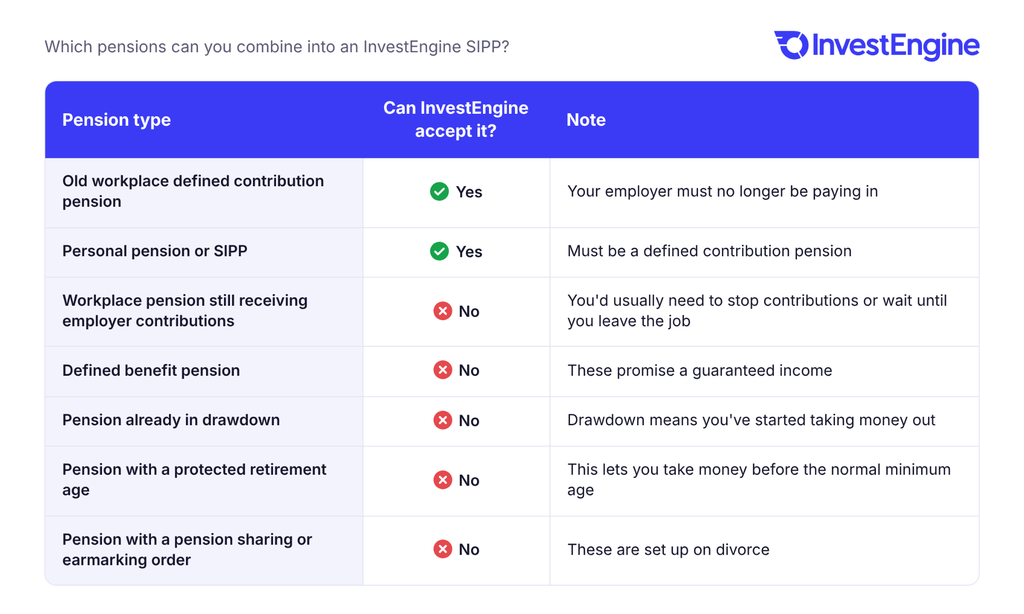
InvestEngine doesn’t accept partial transfers, so each pension you transfer has to move in full. If you’re not sure what type of pension you have, ask your current provider before you start.
How do you find your old pensions?
You can usually find old pensions by checking your own records first, then contacting old employers or providers. If you’ve lost track, the government’s free Pension Tracing Service can help you find a provider’s contact details.
- Check your paperwork. Old payslips, P60s, annual pension statements and welcome letters often show the provider’s name and your policy number.
- Contact old employers. Your old HR or payroll team can usually tell you which provider ran the workplace pension.
- Contact the provider. Once you know the provider, ask for your policy number, current value and details of any guarantees or exit fees.
- Use the Pension Tracing Service. The Pension Tracing Service can find contact details for a pension provider if you know the name of the employer or provider. It won’t tell you whether you have a pension or what it’s worth.
What should you check before you combine your pensions?
Before you combine your pensions, check what each one charges, what you might lose and whether the new home suits you. A pension transfer usually can’t be undone, so it’s worth taking your time.
- Exit fees or penalties. Ask each provider whether it charges anything to leave.
- Guaranteed benefits you may lose. Look out for guaranteed annuity rates, with-profits bonuses or a protected pension age.
- Whether the investment options suit your goals. Check the new provider offers the kind of investments you want.
- Your risk tolerance. Think about how comfortable you are with ups and downs in value. Our guide on what to do if your investments drop can help.
- Total costs. Compare the full cost of each pension, including platform fees, dealing fees and fund costs.
If you’re unsure, consider speaking to a regulated financial adviser.
Cash vs in-specie: how do you move your pensions?
You can move a pension as cash or in specie. A cash transfer sells your investments and moves the money, while an in-specie transfer moves your investments without selling them.
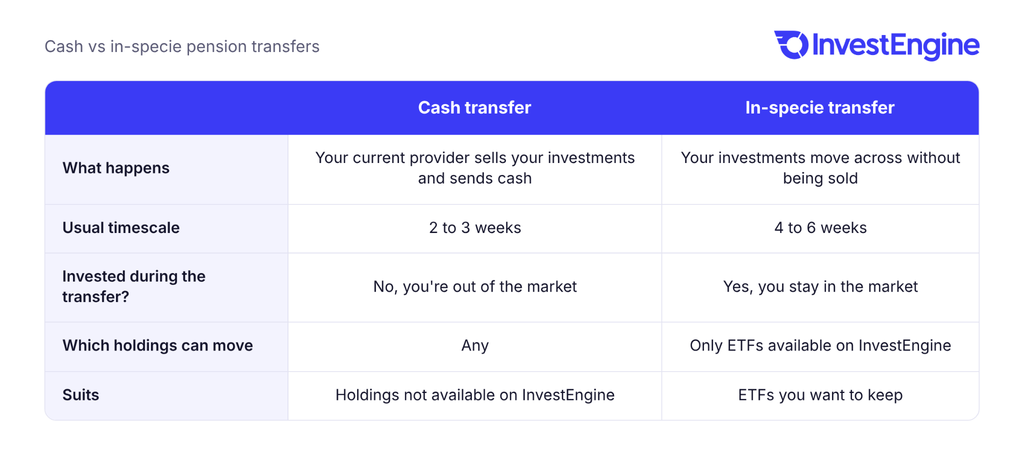
Some providers don’t support in-specie transfers. If both options are available, you choose in the transfer form. If only cash is available, the form will show this.
How do you combine your pensions with InvestEngine, step by step?
You can combine your pensions with InvestEngine by opening a SIPP and requesting each transfer in the app. InvestEngine then contacts your old provider for you.
- Check your pension is eligible. Make sure it’s a defined contribution pension, your employer no longer pays in and it isn’t one of the types InvestEngine can’t accept.
- Choose cash or in specie. Decide whether you want to keep any ETFs you already hold or move everything as cash.
- Set up your SIPP. To open an InvestEngine SIPP, you need to be a UK tax resident and have a National Insurance number.
- Start the transfer. Log in, select ‘Create portfolio or transfer’, then ‘Transfer a pension’.
- Complete the form carefully. Select your provider, make sure your details match your old provider’s records and choose which DIY portfolio the transfer is paid into.
- Track your transfer. You’ll get a confirmation email, and a ‘transfer in progress’ indicator appears on the portfolio. If you have several transfers, you can see them all in the transfer centre.
InvestEngine accepts transfers from many of the UK’s largest defined contribution providers, including Scottish Widows, Hargreaves Lansdown, NEST, Aviva and many more. If your provider isn’t listed, you can submit its details and InvestEngine will look into adding it.
For a full walkthrough, read how to transfer your pension to InvestEngine.
How long does combining your pensions take?
A cash pension transfer to InvestEngine usually takes 2 to 3 weeks, and an in-specie transfer usually takes 4 to 6 weeks. Timings depend on your current provider.
Once your old provider releases the cash, it usually takes 3 to 5 working days to appear in your InvestEngine portfolio. You’ll get emails when cash is received and when ETFs settle.
Some things can make a transfer take longer:
- Extra forms. Some providers need you to fill in extra forms or questionnaires.
- Being over 50. If you’re over 50, your old provider may send you information about drawdown, which can extend the timeline.
Why do pension transfers get delayed, and how can you avoid it?
Pension transfers are most often delayed because your details don’t match your old provider’s records. Checking your details before you submit is the simplest way to avoid this.
- Mismatched details. Your full legal name, date of birth and address need to match what your old provider holds. A maiden name or old address can trigger extra checks.
- Wrong pension reference. Make sure your policy number is correct and in the right format.
- Missed requests. Your old provider may ask you for a form or confirmation by email or post. The transfer can stall until you reply.
- Trading during an in-specie transfer. Avoid buying, selling or rebalancing while the transfer is in progress.
Read our guide to why pension transfers get delayed or cancelled to find out more.
Worked example: combining three old pensions
This example shows how someone might combine three old pensions into one SIPP, and why each pot can move differently.
Hannah has changed jobs three times and has three old defined contribution pensions worth £25,000 in total. Her current employer pays into a workplace pension, which she leaves where it is.
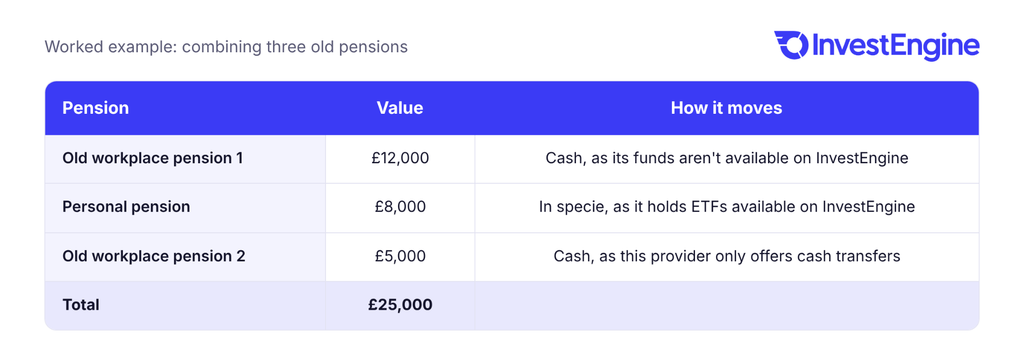
What Hannah checks first
- Her employers no longer pay into any of the three old pensions.
- None of them has exit fees, guaranteed annuity rates or a protected pension age.
- Each pension has to move in full, as partial transfers aren’t accepted.
Hannah starts three transfers. The two cash transfers usually take 2 to 3 weeks, and the in-specie transfer usually takes 4 to 6 weeks. She tracks all three in the transfer centre.
This is an illustration, not a forecast. The value of investments can fall as well as rise.
What happens to tax relief and dividends still due?
Tax relief or dividends still due in your old pension don’t stop your transfer. Your old provider forwards any payments once it receives them, and they’re added to your InvestEngine portfolio when they arrive.
It’s worth contacting your old provider to make sure any remaining balance is sent on.
When can you access your combined pension?
You can usually access your pension from age 55, rising to 57 from 6 April 2028. Combining your pensions doesn’t change when you can access them.
You can usually take up to 25% of your pension tax-free, up to the lump sum allowance of £268,275. The rest is taxed as income when you take it, at your usual income tax rate.
Once you reach the minimum age, you can usually take money from your pension in these ways:
- Drawdown. Take up to 25% tax-free, and leave the rest invested. You then take taxable income when you need it. Your pension can still rise or fall in value.
- Lump sums. Take money out in chunks when you need it. Usually 25% of each lump sum is tax-free, up to your lump sum allowance, and the rest is taxed as income.
- An annuity. Use some or all of your pension to buy a guaranteed income, usually for life.
- Take it all at once. Take your whole pension as cash. Only 25% is usually tax-free, so this could mean a large tax bill in one year.
- A mix. You can combine these options, for example by buying an annuity with part of your pension and keeping the rest in drawdown.
Once you start taking taxable money from your pension through drawdown or lump sums, the most you can pay into pensions with tax relief usually drops to £10,000 a year. This is called the money purchase annual allowance.
A SIPP is designed for long-term retirement investing, so it’s best suited to money you won’t need before then. If you’re unsure which option suits you, Pension Wise from MoneyHelper offers free, impartial guidance if you’re 50 or over.
Should you combine your pensions?
Combining your pensions can make sense if it makes them simpler to manage and doesn’t mean giving up anything valuable. It may be better to leave some pensions where they are.
Combining can make sense when:
- You have several old pensions that are hard to keep track of.
- Your old pensions charge more than you’d pay elsewhere, once you compare total costs.
- You want more control over how your pension is invested.
- Your old pensions have no exit fees, guarantees or special benefits.
It may be better to stay put when:
- Your employer still pays into the pension.
- The pension has guaranteed benefits, such as a guaranteed annuity rate.
- The pension has a protected retirement age.
- Exit fees would outweigh any savings.
- It’s a defined benefit pension.
If you decide to combine, an InvestEngine SIPP has no platform or dealing fees on DIY portfolios (ETF costs apply). If you’re unsure, consider speaking to a regulated financial adviser.
Frequently asked questions
Can I combine my pensions into one?
Yes, you can usually combine old defined contribution pensions by transferring them into one SIPP. Before you move anything, check for exit fees, guaranteed benefits and whether your employer still pays in. Defined benefit pensions, pensions in drawdown and pensions with a protected retirement age may not be accepted by every provider.
Can I transfer part of a pension?
Some providers accept partial pension transfers, but InvestEngine doesn’t. If you transfer a pension to an InvestEngine SIPP, the whole pension has to move. You can still choose which of your pensions to transfer, so you could move some pots and leave others where they are.
Can I transfer a workplace pension I still pay into?
InvestEngine can’t accept a workplace pension that still receives employer contributions. Moving it could mean losing your employer’s payments. You’d usually need to stop contributions or wait until you leave the job before transferring. Many people leave their current workplace pension where it is and combine only older ones.
How long does a pension transfer take?
A cash pension transfer to InvestEngine usually takes 2 to 3 weeks, and an in-specie transfer usually takes 4 to 6 weeks. Timings depend on your current provider. Extra forms, mismatched details or drawdown information sent to over-50s can make a transfer take longer.
Do I lose anything by transferring?
You might. Some pensions have valuable guarantees or benefits, such as a guaranteed annuity rate, a with-profits bonus or a protected pension age, that are lost when you transfer. Some also charge exit fees. Check with your current provider before you transfer, and consider speaking to a regulated financial adviser if you’re unsure.
Can I transfer a defined benefit pension?
InvestEngine can’t accept defined benefit pensions. A defined benefit pension promises a guaranteed income in retirement, which you’d give up by transferring. If a defined benefit pension is worth more than £30,000, you must get regulated financial advice before transferring it to a defined contribution pension.
Does InvestEngine charge platform or dealing fees on a SIPP?
No. InvestEngine doesn’t charge platform or dealing fees on DIY portfolios in its SIPP. ETF costs apply, and these vary by fund. Your old provider may charge exit fees, so check with them before you transfer. Capital is at risk, and the value of your investments can go down as well as up.
Can I keep my SIPP alongside an ISA?
Yes. You can hold a SIPP alongside an ISA and a general investment account. With InvestEngine, you can manage them all in one dashboard. A SIPP usually can’t be accessed until age 55, rising to 57 from 2028, while an ISA lets you withdraw at any time.
What to do next
- List your pensions and check they’re eligible. Find each provider, policy number and pension type.
- Check fees and guarantees. Ask each provider about exit fees and any benefits you’d lose by moving.
- Start the transfer. Open a SIPP and request each transfer in the app.
Important information
Capital at risk. The value of your portfolio with InvestEngine can go down as well as up and you may get back less than you invest. ETF costs apply.
Pension transfers can mean losing valuable guarantees or benefits, so check with your current provider before you transfer. Tax treatment depends on your individual circumstances and may change in the future. This is general information, not financial advice. If you’re unsure, speak to a regulated financial adviser.
If you have questions about transferring, contact support@investengine.com.