


TL;DR: The top 10 ETFs for businesses (based on amount bought on InvestEngine Business accounts between 01/06/25 and 31/05/26) are:
- Amundi Smart Overnight Return GBP Hedged (CSH2)
- Vanguard S&P 500 (VUSA)
- iShares Physical Gold (SGLN)
- Vanguard FTSE All‑World (VWRL)
- Invesco FTSE All‑World (FWRG)
- iShares FTSE 100 (ISF)
- iShares MSCI World Small Cap (WLDS)
- Xtrackers MSCI World Momentum (XDEM)
- Xtrackers MSCI World Quality (XDEQ)
- iShares MSCI World Minimum Volatility (MINV)
Business investing works much the same as personal investing, but the job it does is often very different.
Most businesses want a sensible, accessible way to put surplus cash to work, rather than leaving it in a business bank account. They generally want to keep volatility light, diversify heavily and retain enough liquidity that the cash is accessible if they need it.
Rather than guessing which funds should be popular to achieve these goals, we’ve taken a look at the most bought ETFs in Business portfolios over the last year, to see what our existing business customers are utilising.
Top ETFs Business investors bought on InvestEngine
This list of ‘Top ETFs’ has been calculated by most bought (by number of net trades) between 1 June 2025 and 31 May 2026.
- Amundi Smart Overnight Return GBP Hedged (CSH2)
For businesses holding cash for tax, payroll, or near-term expenses, Overnight Rate ETFs are popular, because they’re designed to target relatively steady returns with relatively low volatility.
This fund aims to deliver short-term returns in line with the Bank of England’s SONIA benchmark, with an emphasis on capital stability rather than long-term equity growth. It’s often used by investors looking to stay invested but avoid taking on too much risk (though it is, of course, still an investment and capital is at risk).
Explore Amundi Smart Overnight Return GBP Hedged (CSH2)
- Vanguard S&P 500 (VUSA)
The S&P 500 is a simple way to access the 500 largest US-listed companies in one go. For many investors, that’s a straightforward “core equity” building block.
This ETF aims to replicate the performance of the S&P 500 index, giving broad exposure to major US businesses across sectors (with a meaningful tilt to large technology names, because the index is market-cap weighted). It’s typically used as part of a broader, well diversified long-term portfolio.
Explore Vanguard S&P 500 (VUSA)
- iShares Physical Gold (SGLN)
Gold typically behaves quite differently to other investments, so it remains popular as a diversification tool.
This ETC provides exposure to the price of physical gold by holding gold bullion. It may appeal to investors who want gold exposure without holding it directly. (As always, concentrated allocations add risk, and many investors keep specialist exposures as a smaller slice of a broader portfolio.)
Explore iShares Physical Gold (SGLN)
- Vanguard FTSE All‑World (VWRL)
If your goal is to keep things simple, global equity ETFs can offer “one fund” exposure to thousands of companies across developed and emerging markets.
This ETF invests across global markets and sectors, aiming to track the FTSE All‑World index. It can be used as a broad, diversified equity core, which could be helpful if you’d rather not decide how much to allocate to each country or region, or want to keep your portfolio simple.
Explore Vanguard FTSE All‑World (VWRL)
- Invesco FTSE All‑World (FWRG)
Another global “all‑in‑one” equity option, this ETF also targets broad worldwide diversification across developed and emerging markets.
It aims to reflect the performance of the FTSE All‑World index, potentially suiting business investors who want a single global equity holding, with diversification spread across regions and sectors.
Explore Invesco FTSE All‑World (FWRG)
- iShares FTSE 100 (ISF)
The FTSE 100 is a familiar index for UK-based investors, representing the largest listed companies in the UK.
This ETF aims to track the FTSE 100 index, providing exposure to a broad set of leading UK firms across industries. It may appeal to investors seeking a UK tilt within an otherwise diversified portfolio.
Explore iShares FTSE 100 (ISF)
- iShares MSCI World Small Cap (WLDS)
Smaller companies can offer higher growth potential, but they tend to come with higher volatility.
This ETF provides exposure to small-cap companies across developed markets globally. It can be used as a “tilt” alongside a core global equity holding, by adding more small-company exposure than you’d typically get in the more famous large-cap indices.
Explore iShares MSCI World Small Cap (WLDS)
- Xtrackers MSCI World Momentum (XDEM)
Momentum investing focuses on companies that have shown strong recent performance or, in other words, have “momentum” (while, of course, acknowledging this can reverse).
This ETF aims to invest in developed-market global companies displaying high momentum, offering an approach that some investors use to complement broader market exposure.
Explore Xtrackers MSCI World Momentum (XDEM)
- Xtrackers MSCI World Quality (XDEQ)
“Quality” strategies typically focus on businesses with characteristics such as stronger profitability, steadier earnings, that kind of thing. Ultimately, it’s businesses that are seen as more ‘solid’.
This ETF targets developed-market global companies with quality characteristics, which may appeal to investors who want equity exposure but prefer a tilt toward financially robust firms.
Explore Xtrackers MSCI World Quality (XDEQ)
- iShares MSCI World Minimum Volatility (MINV)
Minimum volatility strategies aim to reduce the ups and downs of equity investing by selecting a subset of stocks from a broad index designed to have lower overall volatility.
This ETF provides global developed-market equity exposure while targeting lower volatility compared to the broad market. It can suit investors who want to stay invested in equities but would prefer to target a smoother ride (noting that “lower volatility” doesn’t mean “no losses”).
Explore iShares MSCI World Minimum Volatility (MINV)
What to consider before choosing an ETF for a Business account
Before investing business funds, it’s worth getting clear on what the money is for.
Time horizon: Is this long-term capital you won’t need for years, or money you might need for VAT, corporation tax, or payroll?
Risk tolerance: Equity ETFs can fluctuate significantly. If your business needs capital stability, you may prefer lower-volatility approaches (while still remembering capital is at risk).
Diversification: A single-country ETF (like the FTSE 100) is more concentrated than a global ETF. Likewise, specialist exposures (like gold, momentum, quality, min vol, small caps) can be powerful, but should be allocated thoughtfully.
Costs and liquidity: Ongoing charges matter over time, and larger, more liquid ETFs can sometimes trade more smoothly.
What are the risks?
All investing involves risk. The value of investments can go down as well as up, and you could get back less than you invest.
Even diversified ETFs can fall during market downturns, and factor or thematic ETFs can underperform for long periods. Currency movements can also affect returns on international investments.
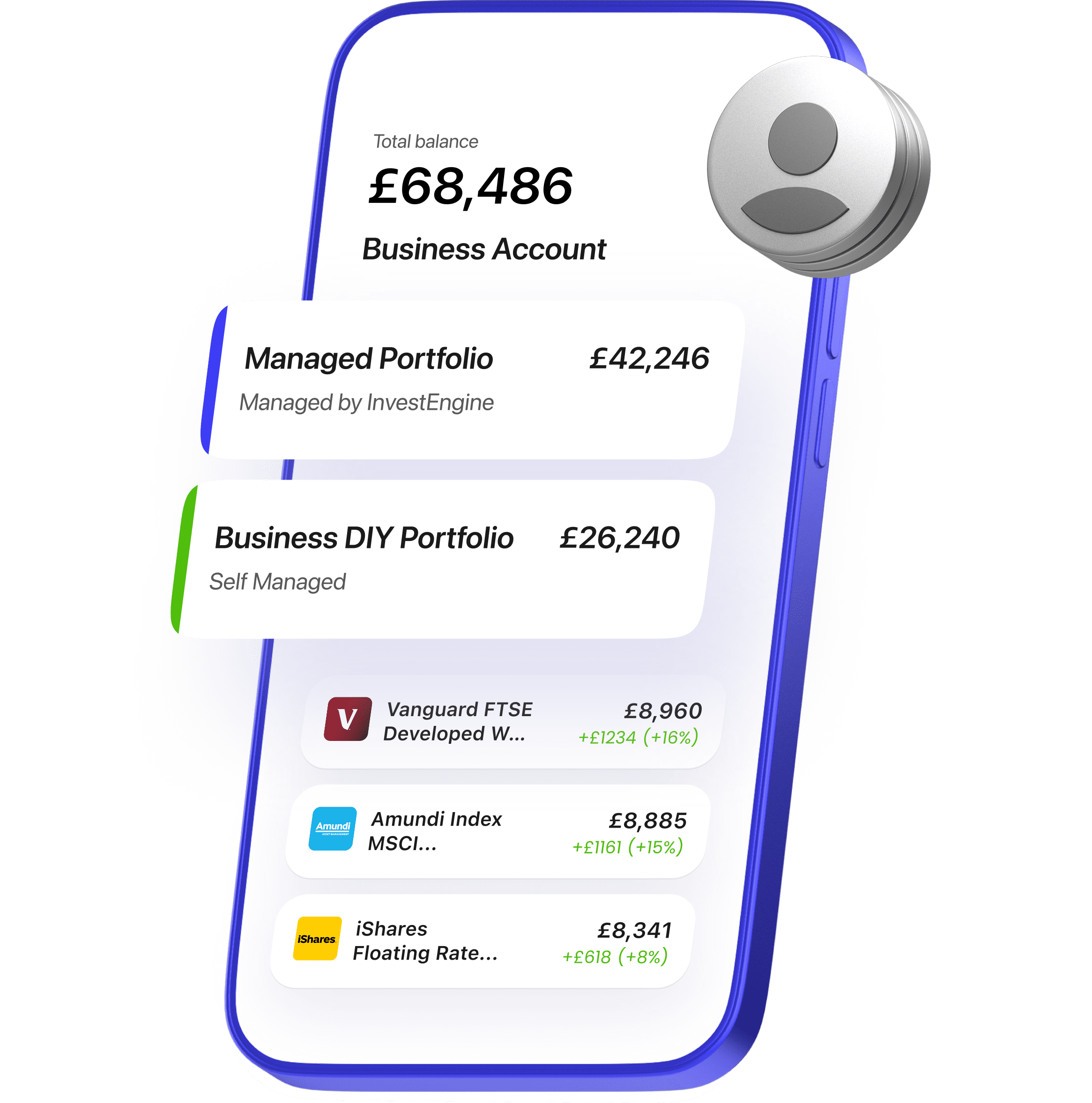
Put your business cash to work
Take advantage of powerfully simple business investing with InvestEngine. We make it easy to build and maintain a long-term investment portfolio that suits you and your business.
Find out moreCapital at risk. Ts&Cs apply
Important information
Capital at risk. The value of investments may go down as well as up, and you may get back less than you invest. Past performance is not indicative of future performance. ETF costs apply. Tax rules can change and any benefits depend on individual circumstances. If in doubt, consider professional advice.