


If your medical practice’s cash is just sitting in a bank account, chances are it’s not working as hard as it could be. It might even be losing value over time thanks to inflation.
Running a medical practice often means juggling patient care alongside the business side of things, and managing spare cash often falls down the priority list. It’s worth asking whether this cash could be doing more for you, and how much of it you need for the short, medium, and long-term.
Now, of course, that doesn’t mean you should pile all of your business cash into the stock market. You don’t need an all-or-nothing approach, because different pots of cash can have different jobs. You just need to make sure you can identify what is spare cash and what isn’t, and then you can start putting your money to work.
Different types of business cash and how to consider them
Day-to-day cash and emergency funds
Day-to-day business cash is the money you use to keep the business running, like payroll, rent, and other more routine expenses. Whereas emergency funds are there for the unexpected: a delayed payment from a patient’s insurance, a sudden expense or even a slowdown in business.
For essential spending money that you might need immediately, a business current account is usually the safest option, even if it’s paying measly returns.
For day-to-day expenses, instant access matters more than returns.
Short-to-medium term cash (three months to three years)
This is cash that probably won’t be needed for tomorrow, next week or even for next month.
It might be earmarked for things like paying tax bills, buying equipment, hiring additional nurses, or expanding your medical practice.
Ultimately, it’s cash that’s potentially not worth just keeping in a business current account.
It could be working harder, offering potentially higher returns, with more chance of beating inflation. Many investors choose a lower risk option for this timeframe.
This could be particularly useful for investors setting aside cash to pay tax, like VAT or corporation tax.
What are Overnight Rate exchange-traded funds (ETFs) and why do investors use them?
An Overnight Rate ETF is a type of fund that aims to track the SONIA (Sterling Overnight Index Average) rate. The SONIA rate reflects the average interest rate that banks pay to borrow overnight from other financial institutions and other institutional investors. The benchmark essentially tracks the base interest rate set by the Bank of England.
The current targeted return for these funds is 3.73%, in line with the Bank of England’s overnight interest rate benchmark.
Ultimately, they aim to give you a higher return than cash (like a regular current account), but without the volatility that might arise when investing in stocks.
It should be noted that although low risk, an overnight rate ETF isn’t a risk-free investment. There’s always the risk that you get back less than you invested.
“With higher interest rates and uncertain markets, Overnight Rate ETFs can be a smart place to hold short‑term cash without leaving potential returns on the table.”
Haneen Sakhi, Product Specialist, Xtrackers by DWS
Want to invest in Overnight Rate ETFs?
If you’re looking to make more of your business cash and to try and beat what your bank is paying you, then it could be worth investing in an Overnight Rate ETF like the Xtrackers GBP Overnight Rate Swap ETF, or the Amundi Smart Overnight Return ETF. These ETFs aims to replicate the performance of the SONIA rate.
The ETF is aimed at investors looking for a lower risk place to keep their money, with the potential for a little more growth than a traditional savings account. It invests in very short‑term, high‑quality debt from governments and companies, making it less risky by design. This fund may appeal to investors who need their money to be relatively accessible and want to avoid the ups and downs of the stock market.
Medium-to-long term cash (3 years or longer)
If your business has money that it’s not planning to use in the next few years then it could be worth considering investing it in the stock market.
It has a higher chance of bringing in greater returns over the long term than cash and Overnight Rate ETFs, but will come with more ups and downs.
Generally the longer your time horizon, the more risk you can take – for example investing more in stocks and less in bonds.
A common approach is to invest in a number of different types of investments, like stocks, bonds and commodities, but also in different parts of the world. This helps to diversify the portfolio, meaning all the eggs aren’t in one basket. The idea is that is one area of your portfolio underperforms, another is able to lift it to balance it out..
ETFs are a simple and low-cost way to invest in lots of different assets like stocks and bonds, from all over the world. As they’re mainly designed to track the performance of an entire stock market or ‘index’, like the S&P 500 for example, they can help give you instant diversification.
Read our beginner’s guide to investing in ETFs
What about tax?
Tax is a very important part of the discussion when it comes to investing business cash.
As a self-employed business owner, doctors who run their own practice may choose to take the majority of their income from their companies as dividends because it’s usually more tax efficient.
The general idea of investing via your company, however, is that rather than paying out profits in the form of dividends – and being subject to dividend tax – you can keep the cash inside the business and invest any business profits before paying dividend tax.
This doesn’t mean you pay no tax – you’ll have to take the cash out at some point. But because most people have lower incomes later in life, the eventual dividends will most likely be taxed at a lower dividend tax rate than you’d pay if you withdrew the cash today. So the tax isn’t avoided, it’s deferred until later on in life.
If you’re in the fortunate position of having already maxed out your pension allowance, investing through your business is especially useful. Because any contributions into your pension above the annual allowance are taxed at your income tax rate.
So if you’ve already maxed out your pension allowance but still want to invest tax efficiently, then doing so through your business can be a great option.
However, it’s important to consider the tax implications from a business point of view too.
HMRC will look at a company’s ‘trading’ and ‘non-trading’ activities, and whether they’re substantial or not. For example, overnight rate ETFs might be able to be considered as a ‘trading’ activity if they’re genuinely earmarked for trading purposes.
It means that, if you’re considering investing business cash, it’s worth getting professional tax advice to make sure you’re being as tax efficient as possible.
Ready to invest your business cash?
If you’re looking to invest in the stock market for the longer term and can handle the volatility that comes with stocks over cash and Overnight Rate ETFs, then you could consider a global stock market tracker.
ETFs like the Invesco FTSE All-World, Xtrackers FTSE All-World, and Vanguard FTSE All-World offer investors the opportunity to invest in a wide range of companies from across the globe, including both developed and emerging markets. It aims to mirror the performance of the FTSE All‑World index, providing diversified exposure to the world’s stock markets.
These ETFs might appeal to those looking to spread their investment across different countries and sectors, potentially reducing risk while potentially benefiting from broad global market growth.
Put your medical business cash to work
Take advantage of powerfully simple business investing with InvestEngine. We make it easy to build and maintain a long-term investment portfolio that suits you and your medical business.
Capital at risk. Ts&Cs apply
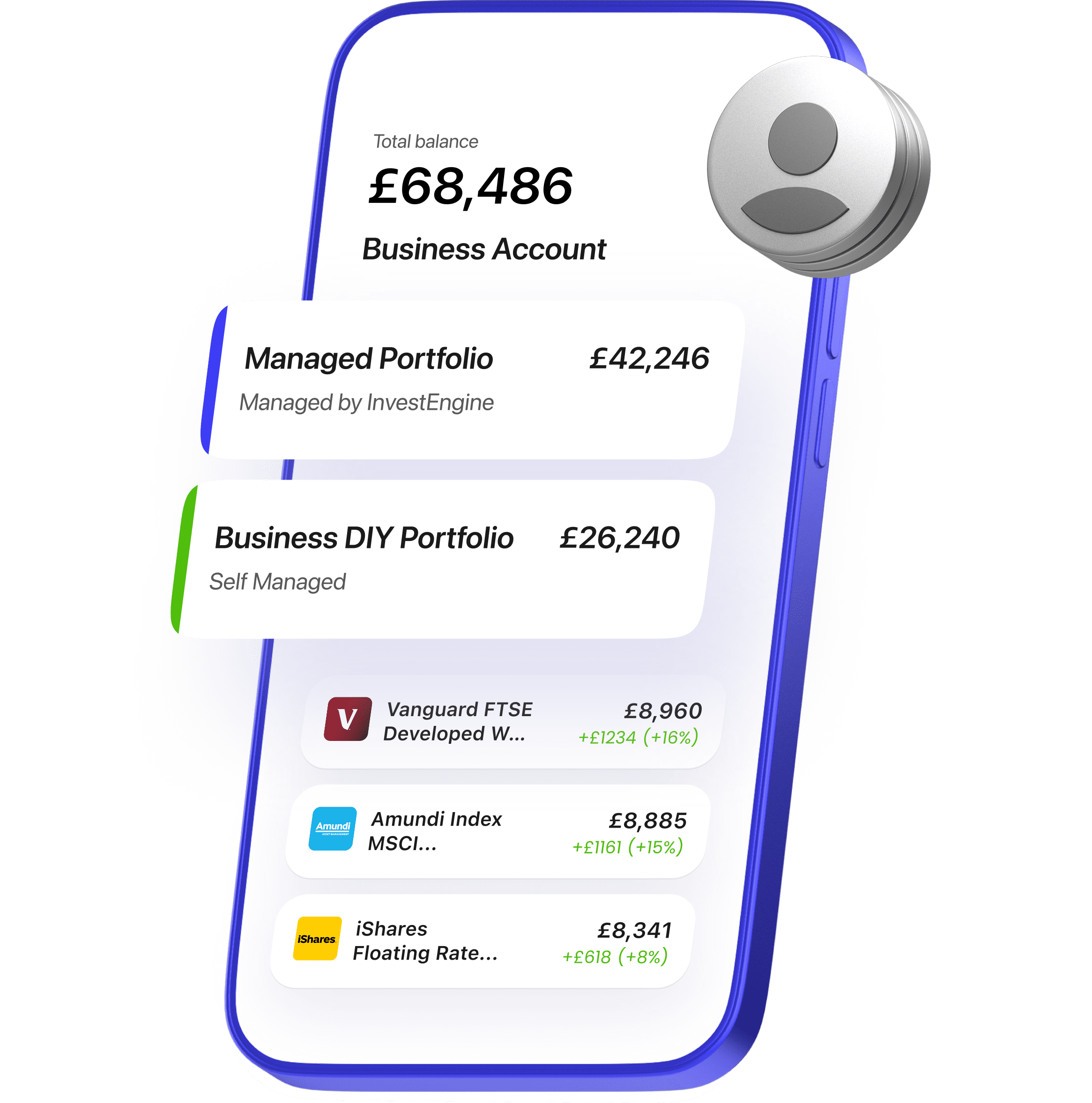
Image above for illustration only.
Important information
Capital at risk. The value of your investments may go down as well as up, and you may get back less than you invest. Past performance is not indicative of future performance.
ETF costs apply. Tax treatment depends on your personal circumstances and may change in future. This information does not constitute financial advice. If in doubt, you may wish to consult a professional adviser for guidance.
ETF issuers mentioned in this article pay InvestEngine a fee for joint marketing activities. This article was not produced in partnership with any ETF provider, but it’s important to disclose that these arrangements are commercial in nature and help support the creation and promotion of educational content and ETF investing.