


TL;DR: Building a Business Account portfolio is mainly about matching each pot of company cash to its time horizon: short-term reserves can sit in lower-volatility ETFs, while long-term retained profits can take more market risk for potential growth. A simple “core + satellites” ETF approach helps you diversify without turning investing into a second job.
When you invest in a Business Account, you’re investing company money. So, it’s not usually a case of stock picking or trying to wildly outperform the market.
When businesses invest, they generally do it to put surplus business cash to work, in a way that fits cashflow needs, risk appetite, and time horizon.
This guide explains how to build a diversified ETF portfolio for your business. You start with a core, add a small number of satellites, and keep the whole thing aligned to what the money you’re investing is actually for.
Before you start: what is the money you’re investing for?
For most businesses, building the right investment portfolio starts with one question: when do we need this cash?
A common way to think about business cash is in tiers:
- Tier 1: Operating cash (days to weeks): payroll, suppliers, rent, VAT flows. Usually best kept in a business current account as cash savings.
- Tier 2: Short-term reserves (months to 1 year): money you might need, but not on a precise date (buffer for slower trading, tax bills you’re working toward, planned spend with flexible timing).
- Tier 3: Long-term surplus (1–5+ years): retained profits you don’t expect to use soon (e.g. building runway, future expansion, long-term capital).
The sooner you think you’ll need the money, the more the portfolio should prioritise stability and liquidity over chasing returns.
Why ETFs work well for Business Accounts
ETFs (exchange-traded funds) are a practical building block for business investing because they can help you:
- Diversify quickly (one ETF can hold hundreds or thousands of underlying investments)
- Keep costs low and transparent (fees are shown on the fund documents)
- Build portfolios by asset type (bonds, equities, commodities), region, sector, or theme
InvestEngine Business Accounts are all built using ETFs, so you’re not picking individual shares. You’re choosing funds that each hold a basket of investments.
Step 1: set your time horizon and risk tolerance
Different ETFs serve different purposes, with the key factor being how long you’re investing for and how much volatility you can handle as a result.
Three practical questions to ask yourself when thinking about this:
- How quickly would we need this money in a worst-case scenario?
- How much short-term loss could the business tolerate without creating stress or operational issues?
- Is this money earmarked for a specific bill on a specific date? (If yes, certainty may matter more than return.)
This is probably the most important step of the process, as it informs everything that comes after it. If you’re not sure what’s appropriate for your situation, speak to your accountant and/or a qualified financial adviser.
Step 2: build a diversified “core”
Most portfolios benefit from a simple core holding (or two) that does a lot of the heavy lifting. For business investing, the core is typically chosen to match the time horizon:
Examples of potential cores
- Short-term reserve core: a lower-volatility approach designed for cash that needs more flexibility (think near-term projects or tax money you’re building up).
- Long-term surplus core: a broad global equity ETF (or a blend of global equity + bonds) designed for long-term growth, accepting that the value can fall in the short term.
The goal of the core isn’t to be exciting. It’s to be broad, diversified and easy to stick with.
Step 3: decide your asset allocation
The asset allocation of your core is the mix of different building blocks you use for it. The most popular categories are:
- Equities: higher long-term growth potential, higher volatility.
- Bonds: typically seen as steadier than equities, can provide diversification and income (but still carry risk).
- Commodities (e.g. gold): can behave differently to equities and bonds and may help diversify, but can be volatile.
A common way to build a business portfolio is essentially:
- A “core” holding (or two)
- A small number of additional holdings to tweak risk, increase diversification, or factor in your preferences
Step 4: add a small number of satellites
Once your core is established, you can add to it if you wish. Satellites are smaller, optional positions you add around the core.
Reasons a business might add satellites:
- To reduce concentration risk (e.g. balancing a strong US tilt with broader exposures)
- To express a business view (e.g. avoiding overexposure to a single sector your business already depends on)
- To align with values/preferences (e.g. ESG-screened ETFs)
- To add a diversifier (e.g. a small allocation to commodities)
A good rule of thumb: keep the number of satellites small and make them intentional. Too many holdings often makes a portfolio harder to monitor and, as a result, easier to abandon.
Step 5: decide how you’ll invest lump sum vs regular contributions
Whether you’re investing for your businesses or as an individual, you have two common ways to invest:
- Lump sum: moving a portion of accumulated surplus cash into the portfolio.
- Regular contributions: investing a set amount monthly (useful for smoothing out your entry into the market and building the habit).
Regular investing is sometimes called “pound-cost averaging”: investing the same amount at regular intervals to smooth out your investing, rather than trying to time the market.
Step 6: monitor and rebalance where needed
A business portfolio doesn’t need daily attention, but you should check in on it regularly enough to keep it on track.
Rebalancing means bringing your portfolio back to your intended mix when market moves push it off course. So, if you initially chose 30% of your portfolio to be made up of an S&P 500 ETF, you want it to stay that way.
For example, if equities rise faster than bonds, your portfolio can become riskier than you’d planned as the equity allocation outgrows that of bonds. Rebalancing the portfolio brings it back to its target.
For many investors, reviewing once or twice a year is enough. It’s also important to review your progress whenever your business’s circumstances change.
Common mistakes businesses make
- Investing operating cash: money needed for payroll/tax deadlines shouldn’t depend on markets.
- Overcomplicating the portfolio: too many ETFs in a portfolio creates admin and makes it harder to stick with the plan.
- Chasing recent winners: buying what performed best last year can backfire and isn’t the goal for long-term, diversified investing.
- Not defining the time horizon: the same investment can be successful over a 10-year period, but painful over 6 months.
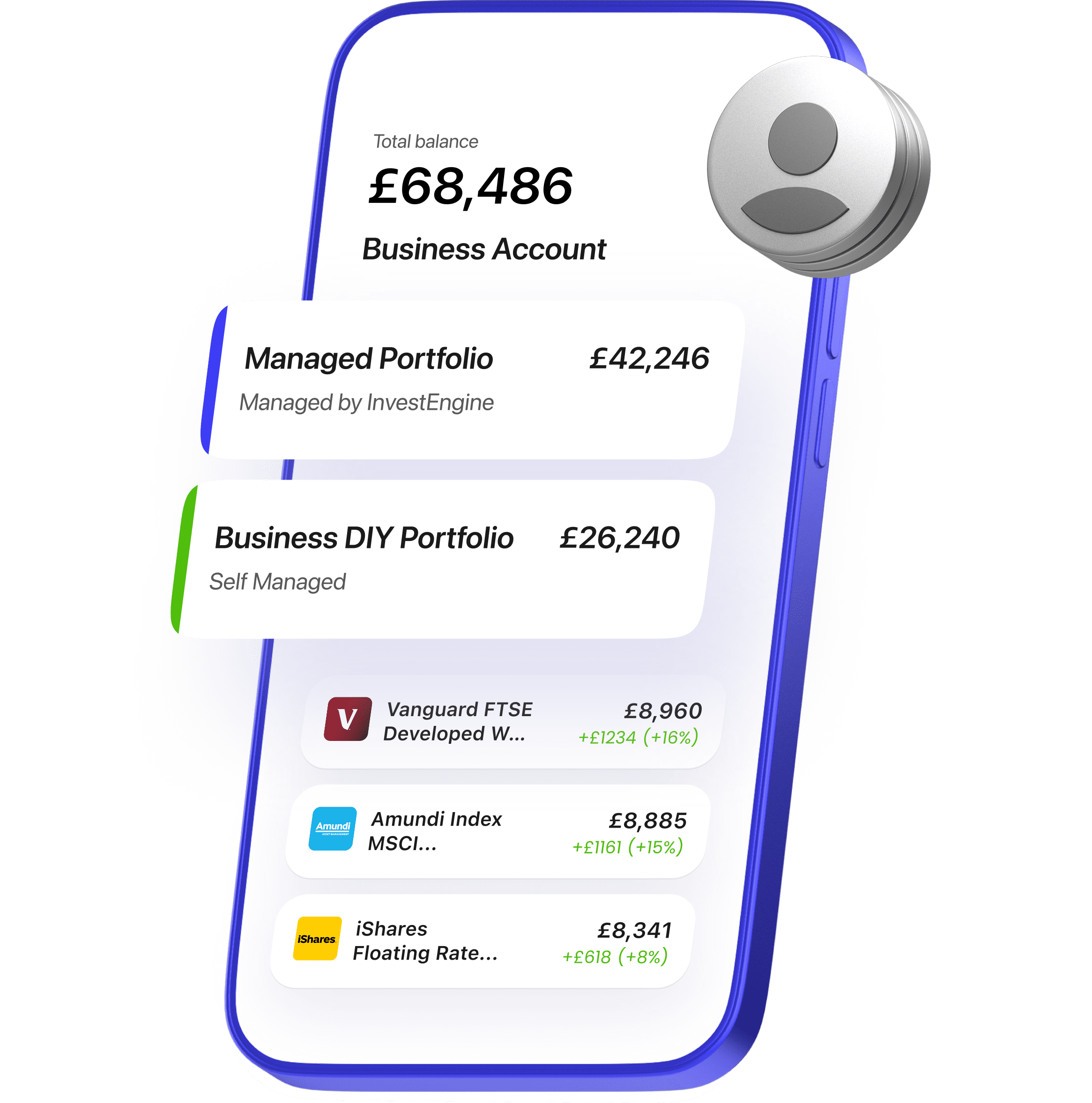
Put your business cash to work
Take advantage of powerfully simple business investing with InvestEngine. We make it easy to build and maintain a long-term investment portfolio that suits you and your business.
Find out moreCapital at risk. Ts&Cs apply
FAQ
How many ETFs should a business hold?
Many people keep it simple with 3–5 ETFs (a core plus a satellite or two). More isn’t automatically better.
Are bonds risk-free?
No. Bonds can still fall in value, and different bond types carry different interest-rate and credit risks.
How liquid is a Business Account?
You can sell and withdraw at any time, but it typically takes a few business days for cash to reach your bank account once you sell down investments.
Important information
Capital at risk. The value of your portfolio with InvestEngine can go down as well as up and you may get back less than you invest.
ETF costs also apply. Past performance is not a reliable indicator of future results. This communication is provided for general information only and should not be construed as advice. Tax treatment depends on individual circumstances and is subject to change.