


Summary
A fall in value doesn’t, on its own, mean an investment isn’t working. To judge it, look at your goal, your timeframe, how the investment has done against its benchmark and whether your portfolio is properly diversified. Selling after a fall turns a paper loss into a real one, so it’s worth checking these things before you act.
Why do investments drop in value?
Investments drop in value because markets move up and down all the time. These movements are called volatility, and they’re a normal part of investing in shares and bonds. Market falls vary in size and length, from a few days to several years.
Some of the most common causes of falls are:
- Market-wide falls. Worries about the economy, politics or company profits can push down prices across most markets at once. This is often called systematic or market risk.
- Interest rate changes. When interest rates rise or are expected to rise, bond prices usually fall, and share prices can fall too.
- Weakness in a sector or region. An investment focused on one industry, such as technology, or one country can fall even when wider markets are steady.
- Currency moves. If you hold overseas investments, a stronger pound against the currency they’re priced in can reduce their value in pounds, even if their prices haven’t changed in their own currency. For example, if the pound rises against the US dollar, your US shares are worth fewer pounds, even if their price in dollars stays the same. This can make your investments perform worse in pounds. The opposite is also true: a weaker pound can boost the value of overseas investments.
Does a fall mean your investment is not working?
A fall doesn’t automatically mean your investment isn’t working. What matters is why it has fallen. A fall that affects the whole market is very different from a problem specific to your investment.
A market-wide fall means most investments are down together. If your global ETF (exchange-traded fund, a low-cost fund that tracks a market index) has fallen by roughly the same amount as the index it tracks, it’s doing what it was designed to do.
A problem specific to your investment means it has fallen much more than similar investments, or for a reason that changes the case for holding it. That might be a single company in trouble, a fund that’s far more concentrated than you realised, or costs that are eating into returns.
How do you judge whether your investments are working?
You can judge whether your investments are working by checking them against your plan, not against yesterday’s price. These five questions can help:
- Have your goals and timeframes changed? If you’re still investing for something 20 years away, a fall today gives your investments time to recover, though there’s no guarantee they will. If you now need the money next year, a fall matters more, and it may be worth reviewing your plan.
- How does the fall compare with its benchmark? A benchmark is the index or market your investment is designed to track or beat. If your ETF is down 15% and its index is down 15%, it’s behaving as expected.
- Are you properly diversified? Diversification means spreading your money across many companies, sectors, regions and types of investment. If one holding makes up a large part of your portfolio, a fall in it will hit harder.
- Are your costs reasonable? Fund charges and platform fees are taken whatever the market does. Higher costs can reduce your returns over time.
- Are you investing for the right timeframe? Investing generally suits goals at least five years away. If you’ll need the money sooner, your plan may need a different approach.
What is the difference between a paper loss and a real loss?
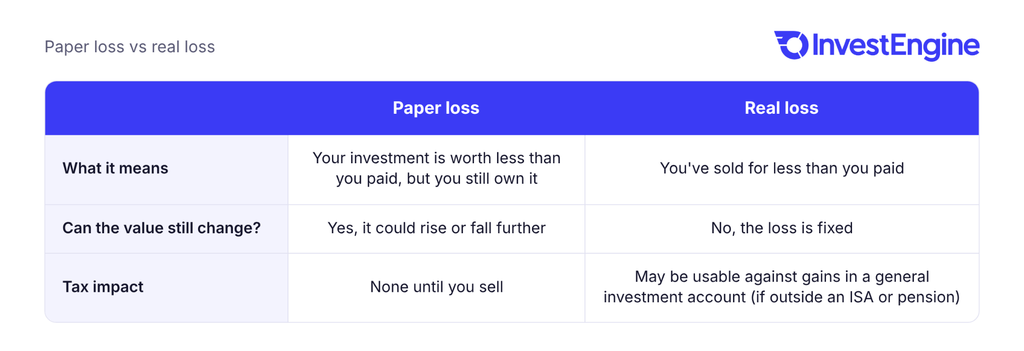
A paper loss is a fall in the value of an investment you still own. A real loss is a loss you lock in by selling for less than you paid. A paper loss can still change in either direction, but a real loss can’t.
Worked example: Jess
Jess invests £10,000 in a global ETF. A few months later, it’s worth £8,000.
- If Jess holds, she has a paper loss of £2,000. The value could rise or fall from here.
- If Jess sells at £8,000, she has a real loss of £2,000. If the market later rises, her money won’t benefit.
This is an illustration, not a forecast. The value of investments can fall as well as rise.
What is panic selling and what does it cost you?
Panic selling means selling quickly because prices are falling, rather than because your plan has changed. The main cost is that it can lock in losses and mean missing any later rises, which have often come soon after the sharpest falls.
J.P. Morgan Asset Management looked at a $10,000 investment in the US stock market between 2 January 2006 and 31 December 2025 (J.P. Morgan Guide to Retirement 2026):
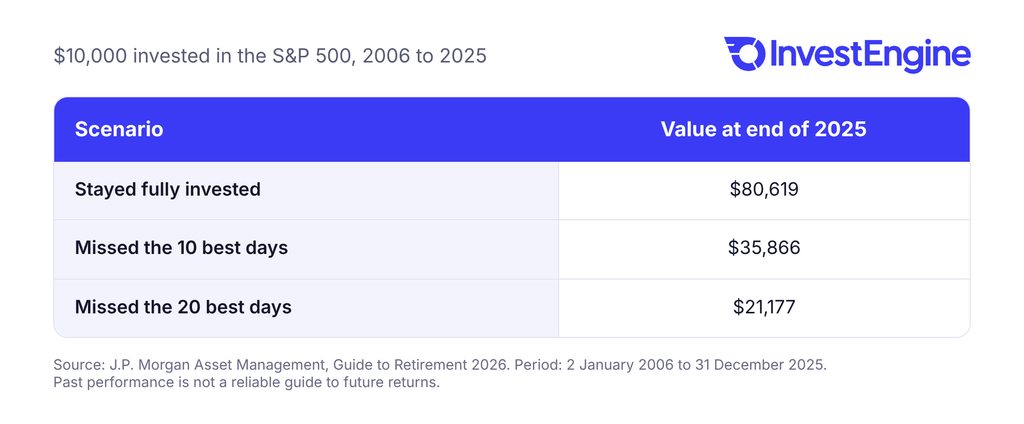
The same research found that six of the 10 best days happened within two weeks of the 10 worst days. What investors can take from this is that selling during a sharp fall can mean being out of the market for any potential rebound.
Remember that past performance isn’t a guide to the future and no returns are ever guaranteed. These figures are for a US index in US dollars.
When should you review or change an investment?
It can make sense to review or change an investment for reasons that have nothing to do with a short-term fall in price. These are some legitimate reasons to take another look:
- Your goal or timeframe has changed. You may need the money sooner, or for something different.
- The investment no longer fits your plan. It may be riskier, or less suited to your goal, than you first thought.
- You’re too concentrated. One company, sector or region makes up too much of your portfolio.
- Costs are high. You’re paying more than you need to for similar exposure.
- The investment has changed. For example, a fund has changed its strategy or the index it tracks.
Some investments do fall for good reasons, such as a company’s prospects getting worse. Reviewing the reasons for a fall is different from reacting to the fall itself.
How does diversification help when markets fall?
Diversification is spreading your money across many different investments so that a fall in one has less effect on the whole. It doesn’t stop your portfolio falling in a market-wide drop, but it can reduce the impact of problems in a single company, sector or country.
A single global ETF lets you invest in thousands of companies. Combining ETFs that track shares, bonds and different regions can spread your risk further.
With InvestEngine, you can build your own diversified ETF portfolio, choosing from hundreds of different ETFs, from global, emerging and developed market trackers to gold, thematic and active ETFs (ones that try and beat the market).
Does it matter which account you hold your investments in?
Yes. Selling investments inside an ISA or SIPP doesn’t trigger capital gains tax, but selling in a GIA (general investment account) can.
- ISA and SIPP: you pay no capital gains tax when you sell. A SIPP (self-invested personal pension) is locked until the normal minimum pension age, which is currently 55 and rises to 57 from 6 April 2028.
- GIA: selling at a profit can trigger capital gains tax on gains above £3,000 in 2026/27. Selling at a loss may give you a loss you can use against future gains.
Read our guide to ISA vs SIPP vs GIA: which account should you open? to find out more.
What can you do instead of selling?
Selling isn’t the only option when your investments fall. Depending on your situation, these are some of the things investors consider:
- Do nothing and review on a schedule. Set a regular date, such as every six or 12 months, to check your investments against your plan.
- Keep investing regularly. Paying in a set amount each month means you buy more units when prices are lower and fewer when they’re higher. This is called pound-cost averaging and it’s one of the most popular ways to invest for the long term.
- Rebalance. If a fall has moved your portfolio away from your target mix, you can bring it back in line.
- Speak to a regulated financial adviser. If you’re unsure what to do, an adviser can look at your full situation.
Frequently asked questions
Should I sell when my investments fall?
A fall alone isn’t usually a reason to sell. Before deciding, check whether your goal and timeframe have changed, how your investment compares with its benchmark, and whether you’re diversified. Selling turns a paper loss into a real one so make sure you are confident with your decision and are selling for the right reasons, not just because your portfolio has fallen. Remember, investing is for the long term.
How do I know if my investment is doing badly?
Compare your investment with its benchmark, the index or market it’s designed to track. If it has fallen by about the same amount, it’s likely behaving as expected. If it has fallen much more than similar investments, check why. High costs, poor diversification or a change in strategy can all be signs worth reviewing.
What is a paper loss?
A paper loss is a fall in the value of an investment you still own. For example, if you invest £10,000 and it’s now worth £8,000, you have a £2,000 paper loss. It only becomes a real loss if you sell. While you hold, the value can still rise or fall.
How long do markets take to recover?
There’s no set time, and no guarantee that a market will recover. Some falls have reversed within months, while others have lasted years. Just remember that past performance is not a reliable guide to future returns.
Is it a bad time to invest after a fall?
No one can reliably predict short-term market moves, so there’s no way to know if a fall will continue. Many investors pay in regularly so they don’t have to pick a moment. What’s important is time in the market, not trying to time it.
Can I lose all my money in an ETF?
Any investment can fall in value, and you may get back less than you put in. A broad ETF spreads your money across many companies, which reduces the risk of one failure hurting you. But broad funds can still fall sharply, and ETFs focused on one sector, theme or country, or that use leverage, can fall much further. At InvestEngine we don’t offer leveraged ETFs.
Does a fall in my ISA affect my allowance?
No. Your ISA allowance is based on how much you pay in, not on the value of your investments. In 2026/27, you can pay in up to £20,000, whether your ISA rises or falls. A fall doesn’t give you extra allowance, and a rise doesn’t use any up.
Should I check my investments every day?
You don’t need to check your investments every day if you’re investing for the long term. Daily prices can move a lot and may tempt you to react to short-term news. Many investors set a regular review date, such as every six or 12 months, to check their investments against their goals.
What to do next
- Check your goal and timeframe. Make sure your investments still match what you’re saving for and when.
- Review your diversification. Look at how much you hold in any single company, sector or region.
- Set a regular review date. Pick a date every six or 12 months to check in, rather than reacting day to day.
Important information
Capital at risk. The value of your investments can go down as well as up and you may get back less than you invest. Past performance is not a reliable guide to future returns. ETFs carry costs, and their value can fall as well as rise. Tax treatment depends on your individual circumstances and may change in the future. The Financial Services Compensation Scheme doesn’t cover falls in the value of investments. This is general information, not personalised advice.