

TL;DR UK limited companies don’t pay Capital Gains Tax personally. They generally pay Corporation Tax on their profits, which can include trading profits, investment income (interest/dividends), and gains on selling investments. The exact treatment depends on what the business invests in and the company’s wider tax position.
This article is general information, not tax advice. Tax rules change and can be complex. Speak to your accountant or tax adviser for advice on your company’s situation.
This article was created in conjunction with Ecommerce Accountants.
Why tax matters when a business invests
When a company invests surplus cash, it usually creates one (or more) of these tax “moving parts”:
- Income (e.g. bond interest, money market fund distributions, some fund income)
- Dividends (from share-based investments and equity funds)
- Gains/losses when investments are sold
- Foreign withholding taxes (sometimes deducted before an overseas dividend is paid)
Those items typically feed into the company’s overall Corporation Tax position.
Companies pay Corporation Tax on profits, not CGT
HMRC treats limited companies differently from individuals: companies generally pay Corporation Tax on profits and gains, rather than Capital Gains Tax.[1][2]
So when you see “capital gains” on an investment report, a company may still have tax to consider, just under Corporation Tax rules rather than personal CGT.
Common tax touchpoints when investing company cash
A useful way to think about business-investing tax is: (1) what you hold, (2) what happens during the year (income + sales), and (3) what your accountant needs to file. The same “investment return” can be treated differently depending on the underlying instrument and (sometimes) the company’s accounting treatment.
1) Dividend income: often exempt, but not always
Many UK and overseas dividends received by UK companies are often exempt from Corporation Tax, but the exemption depends on conditions and classifications.[3]
Practical takeaway:
- Your accountant will usually want to know what dividends were received, from where, and whether any tax was withheld overseas.
2) Interest income and fund distributions
Not all “income” is treated like a dividend. For example:
- Bond interest and many cash-like fund distributions are often treated as interest/income for companies, and are commonly taxable under Corporation Tax (depending on the instrument and accounting/tax rules).
- Some investment products blur the lines (especially funds), and the tax classification can be technical.
Practical takeaway:
- Track what type of product you hold (e.g. equities vs bonds vs money market funds), not just “income”.
3) Profits/losses when selling investments
When a company sells an investment, the difference between sale proceeds and the company’s cost base can create a gain or loss that feeds into Corporation Tax.
Practical takeaway:
- “We haven’t withdrawn money” doesn’t necessarily mean “no tax impact”. Sales inside the account can matter (rebalancing, portfolio changes, etc.).
4) Foreign withholding tax on overseas dividends
The UK generally doesn’t levy withholding tax on dividends paid by UK companies, but other countries may withhold tax on dividends paid to a UK company.[4][8]
Practical takeaway:
- If you invest globally, you may see withholding tax deducted before dividends hit your account.
- Your accountant may be able to consider double tax relief in some circumstances (highly fact-dependent).[3]
5) Record-keeping and evidence
Companies are required to keep accounting records including details of assets owned and information needed to prepare accounts and a Company Tax Return.[5]
Practical takeaway:
- Make sure you can provide your accountant with statements, tax certificates, and (ideally) an annual summary of activity.
6) Different investment types can have different tax/reporting profiles
Below is a practical “what it often looks like” guide. Your accountant should confirm the treatment for your company and the specific funds/instruments you hold.
- Cash / bank interest (business savings): usually interest income, included in profits for Corporation Tax.
- Bonds / bond funds: returns are typically interest-like income, and selling can create gains/losses.
- Money market funds / cash-like ETFs: often generate interest-like returns (even if the platform describes it as “yield”).
- Equity funds / equity ETFs: may generate dividends (often exempt for companies, depending on conditions) and gains/losses when sold.
- UK REITs: property income distributions received from a UK REIT are treated as if they were profits from a UK property business (so they may be taxed differently from “ordinary” dividends).[3]
7) “Tax” vs “accounts” (and why both matter)
Accountants generally prepare:
- Statutory accounts (Companies House filing) using UK accounting rules, and
- Corporation Tax computations (HMRC).
The way an investment is treated in the accounts (e.g. fair value movements vs realised profits) can affect what your company’s P&L looks like, and therefore how your accountant approaches the tax computation. This is one reason it’s worth aligning with the accountant early rather than leaving it until year-end.
8) Timing issues: tax year vs company year-end
Some investment “tax reports” are produced on a tax-year basis (6 April to 5 April), while your company accounts run to your accounting period (your year-end).
Practical takeaway:
- Your accountant may need to apportion income/gains across periods, or rely on transaction-level data rather than a single annual certificate.
9) Losses and “offsetting” (don’t waste them)
If an investment is sold for a loss, that loss may be relevant for Corporation Tax computations (subject to rules and the company’s overall position). It’s worth ensuring the accountant has complete transaction history so nothing is missed.
“Does my industry have special tax concerns?”
Sometimes the tax issues are less about the investment account itself and more about the company’s wider context. Examples of where to be extra careful:
- Regulated businesses (certain financial services, insurance, etc.): may have regulatory capital or investment restrictions that sit alongside tax considerations.
- Property-heavy companies: may have additional considerations if investing through property structures or holding property-related investments.
- Groups/holding companies: dividend exemptions and group structures can create different outcomes vs a simple owner-managed trading company.[6]
- Trading status and reliefs: if a company holds substantial non-trading assets (cash/investments), that can sometimes affect whether it’s considered a “trading company” for certain reliefs in wider planning contexts (typically relevant on sale of a company, etc.).[7]
Important: these points are highly situation-specific. They’re prompts to discuss with your accountant rather than universal rules.
Checklist: what to discuss with your accountant before investing
- What type of company is this (trading company, holding company, investment company)?
- What’s the company’s accounting period and Corporation Tax position?
- How should investment income and gains be tracked in the bookkeeping?
- How will dividends vs interest be treated for this company?
- If investing globally: how should withholding tax be handled?
- What reports/certificates are needed each year?
Practical examples (to make the mechanics clearer)
Example 1: “We just held investments. Does tax still apply?”
Possibly. If the investments pay dividends or interest/distributions, that’s income to account for. And if there are any sales inside the account (rebalancing, switching funds, selling to withdraw), there may be gains/losses to consider — even if the money never left the account.
Example 2: “We invested for 6 months, then withdrew to pay Corporation Tax”
You may have:
- income received while invested, and
- gains/losses from selling to create cash for withdrawal.
The withdrawal itself is usually just moving company money back to the business bank account; the tax question is typically what happened inside the investment account that period.
Example 3: “We got overseas dividends and they looked smaller than expected”
That can happen if the overseas country withheld tax before paying the dividend (withholding tax).[4] Your accountant may ask for evidence of the gross dividend and tax withheld.
What to keep (so year-end is painless)
- Periodic statements (monthly/quarterly)
- Full transaction history (buys/sells + deposits/withdrawals)
- Dividend/interest summaries
- Evidence of withholding tax (where applicable)
- Any consolidated annual tax certificate / report provided by the platform
Bottom line
Business investing can be straightforward operationally, but tax is rarely “one-size-fits-all”. The best approach is to:
- Keep clean records (statements + annual tax reporting),
- Understand whether returns are coming from dividends, interest, or gains, and
- Speak to an accountant/tax adviser before you begin (and at year-end).
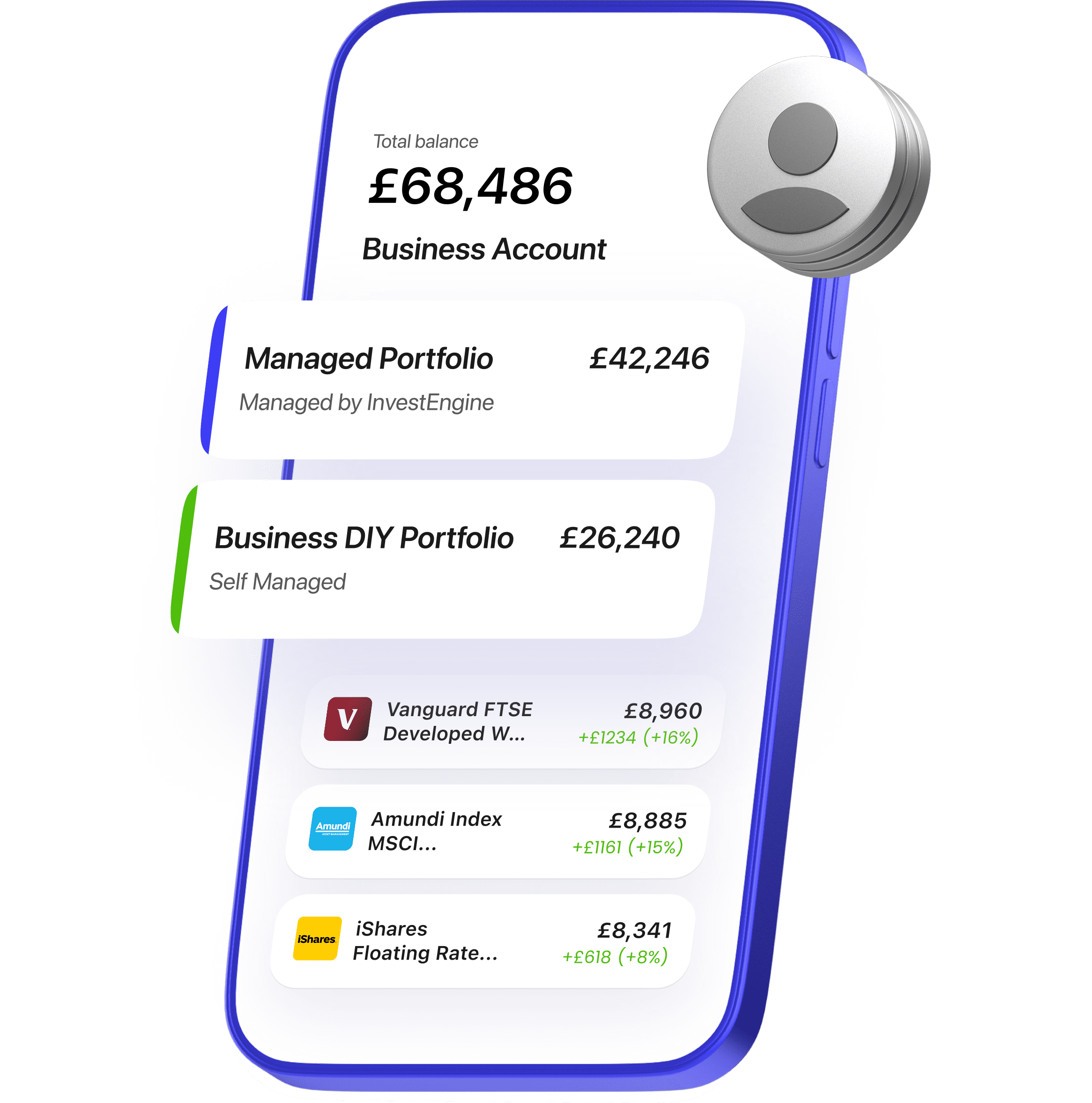
Put your business cash to work
Take advantage of powerfully simple business investing with InvestEngine. We make it easy to build and maintain a long-term investment portfolio that suits you and your business.
Find out moreCapital at risk. Ts&Cs apply
Important information
Capital at risk. The value of investments may go down as well as up, and you may get back less than you invest. Past performance is not indicative of future performance. ETF costs apply. Tax rules can change and any benefits depend on individual circumstances. If in doubt, consider professional advice.