


Pensions have a habit of sitting quietly in the background. You start a new job, join another workplace pension and, before long, you might have different pension pots spread across different providers.
Pension Awareness Week is a good opportunity to give your pensions a quick check-in.
You don’t need to map out your entire retirement. A good place to start is simply knowing where your pensions are, what they’re worth, what they cost and whether they still make sense for you.
Here are six things worth checking.
1. How can I find my old pensions?
Start by working out where all your pensions are held, including any you built up with previous employers.
If you’ve changed jobs several times, you may have more pension pots than you realise. Try checking:
- old pension statements or emails
- previous employers or HR departments
- online accounts with pension providers
- paperwork from previous jobs
If you know who your previous employer was but can’t remember the pension provider, the Government’s free Pension Tracing Service can help you find the scheme’s contact details.
It doesn’t tell you whether you definitely have a pension with that provider or how much it’s worth. Instead, it gives you the details you need to contact the scheme and find out.
Useful links: Government Pension Tracing Service
2. What type of pension do I have?
Before making decisions about an old pension, make sure you understand what type of pension it is and whether it comes with any other benefits or guarantees.
Most pensions fall into two broad categories.
A defined contribution pension builds up a pot of money from contributions made by you and, usually, your employer. That money is invested, so the eventual value depends on contributions, investment performance and charges.
A defined benefit pension, sometimes called a final salary pension, works differently. It generally provides a guaranteed retirement income based on factors such as your salary and how long you worked for the employer.
Some pensions can also contain guarantees or other benefits that could be lost if you transfer them.
Before transferring, check for things such as:
- guaranteed annuity rates or retirement benefits
- enhanced tax-free cash rights
- bonuses or other safeguarded benefits
- exit charges or transfer penalties
If you’re unsure, ask your existing pension provider what benefits apply before making a decision.
3. How much have I actually saved?
Once you’ve found your pensions, get the current values together in one place.
You can normally find your pension value on your latest statement or by logging into your provider’s website or app.
You don’t need an elaborate retirement spreadsheet. Even a simple list can give you a much clearer picture – a basic one might look like this:
| Pension | Current value | Contributions | Fees |
| Current workplace pension | £ | £ | % |
| Old workplace pension | £ | N/A | % |
| Old workplace pension | £ | N/A | % |
| Personal pension/SIPP | £ | £ | % |
It’s also worth checking your State Pension forecast so you can see what you may be entitled to alongside your private pensions.
The goal at this point isn’t to decide what to do. It’s simply to understand what you have.
4. What fees am I paying and where is my pension invested?
Check both what your pension costs and how the money inside it is being invested.
Pension charges vary between providers and products. Depending on your pension, you could be paying platform or administration fees, investment fund charges and other costs.
A difference that looks small as a percentage can become more meaningful when a pension remains invested for decades.
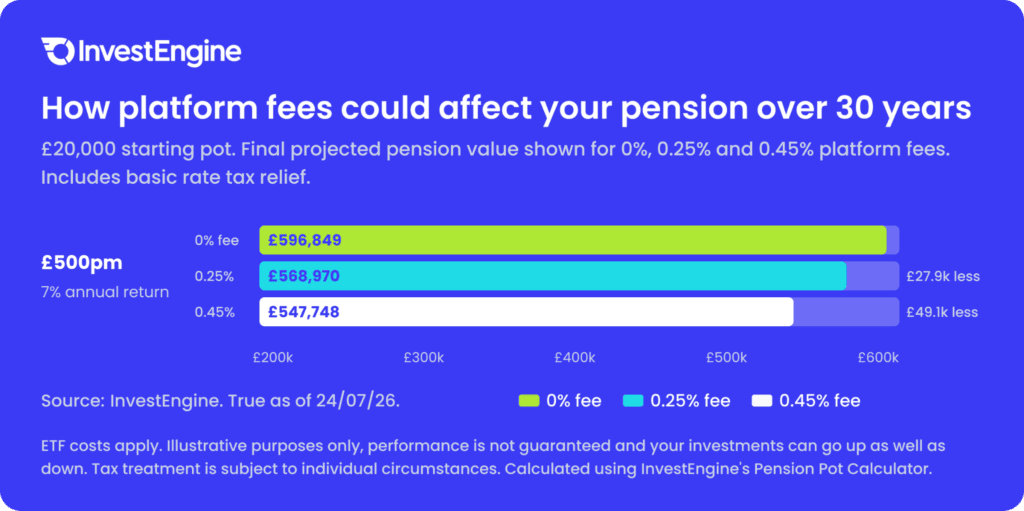
Illustrative example showing the effect of different annual fees over a long investment period. Actual returns are not guaranteed. Values are adjusted to account for the decreasing value of money over time, based on the UK government’s 2% inflation target.
Fees aren’t the only consideration, though.
It’s also worth checking what you actually own inside your pension.
Many workplace pensions automatically invest customers in a default fund. Ask yourself:
- What does the fund invest in?
- Is it diversified?
- How much investment risk does it take?
- Does the investment approach change as you approach retirement?
- Does it still suit your plans?
Try not to judge your pension solely on how it has performed recently. Pensions are long-term investments and markets will rise and fall along the way.
The more useful question is whether the investment strategy and costs still make sense for you.
5. Am I on track for the retirement I want?
There isn’t one pension amount that everyone needs. How much you might need depends on when you want to retire and what you want retirement to look like.
Rather than starting with a giant target number, think about the lifestyle first.
For example:
- Where do you expect to live?
- What might your regular expenses look like?
- How much would you like to spend on holidays, hobbies and leisure?
- At what age would you ideally like to retire?
- What other savings or investments might you use?
You can then compare that picture with what you’re currently saving, your employer contributions and your expected State Pension.
You don’t need to predict your life 30 years from now perfectly.
The useful question is simply:
Based on what I know today, am I heading roughly in the right direction?
If the answer is no, there may be things you can consider, such as increasing your contributions, making the most of employer contributions or reviewing how your pension is invested.
6. Should I combine my old pensions?
Once you know where your pensions are, what they’re worth, what they cost and whether they contain valuable benefits, you’re in a much better position to decide what to do with them.
For some people, bringing eligible old pensions together can make retirement savings simpler to manage.
Having fewer pots can make it easier to:
- see how much you have
- keep track of fees
- manage your investments
- keep your details up to date
- understand how your overall pension is invested
But transferring isn’t automatically the right option.
Before moving a pension, consider the charges, investments and features of both your existing pension and the pension you’re considering transferring to. You should also check whether you could lose guarantees or other valuable benefits, or whether your current provider charges an exit fee.
You generally shouldn’t transfer a workplace pension that your employer is still paying into simply for the sake of consolidation.
InvestEngine currently accepts transfers from many of the UK’s major defined contribution pension providers. Before transferring, customers should consider whether they could incur exit fees, lose guarantees or features, or need existing investments to be sold during the transfer.
One more pension job: check your beneficiaries
There’s one final bit of pension admin worth doing while you’re here.
Check who you’ve nominated as your pension beneficiaries and whether those details are still up to date.
Relationships and circumstances change. If you completed your beneficiary nomination years ago, spending a couple of minutes reviewing it now can make sure it still reflects your wishes.
Pension Awareness Week FAQs
How do I find an old pension?
Start with old statements, emails and previous employers. If you know the name of an employer or pension provider, the Government Pension Tracing Service can help you find the relevant pension scheme contact details.
How can I find out how much my pension is worth?
Check your latest pension statement or log into your pension provider’s website or app. If you have several pensions, add the current values together to get a clearer view of your total private pension savings.
How do I check my pension fees?
Your pension statement or provider should show the charges that apply to your pension. Look at both the cost of the pension itself and any charges associated with the investments held inside it.
Should I combine my old pensions?
It depends. Combining pensions can make them simpler to manage, but transferring could mean giving up valuable benefits or paying additional charges. Check the features of both pensions before deciding.
What should I check before transferring a pension?
Check the type of pension you have, its fees and investments, whether it includes guarantees or valuable benefits, whether there are exit charges and what you’ll pay and receive with the new provider.
Give your pension a quick check-in
You don’t have to solve retirement during Pension Awareness Week.
But knowing where your pensions are, how much you’ve saved, what you’re paying and what your money is invested in gives you a much better starting point.
And if your check-in leaves you with several eligible old pensions scattered across different providers, you can then consider whether bringing them together would make your retirement savings easier to manage.
Capital at risk. The value of investments can go down as well as up and you may get back less than you invest. Tax treatment depends on your individual circumstances and may change.
Pension transfers may not be suitable for everyone. Consider any fees, guarantees and other benefits before transferring. Please note this is not intended to be financial advice or a promise of future performance. You should seek financial advice if in doubt before investing.