


The story of heightened valuations is no news to investors — it‘s been a constant topic of debate for years. While global indices have been re-rated over the last decade, valuations are still different across regions, with some looking more attractively valued than others.
But how can investors spot value opportunities in stock markets?
How to find undervalued stock markets (CAPE ratio explained)
The cyclically-adjusted price-to-earnings ratio (known as the CAPE ratio) compares today’s market price to average company profits over the last 10 years, adjusted for inflation.
Because it looks over a full decade, the CAPE ratio helps smooth out bumps along the economic cycle and gives a more stable view of valuations, rather than just relying on a standard price-to-earnings ratio.
What the CAPE ratio tells investors about future returns
The CAPE ratio doesn’t tell investors what markets will do next. However, historically, markets that start from very high CAPE levels tend to deliver lower long-term returns and markets on lower CAPE levels have tended to do better over the next 10 years on average.
The CAPE ratio is more of a long-term health check for markets rather than a short-term market-timing signal.
Although CAPE can’t tell you exactly when valuations will normalize to revert back to longer-term averages, history does suggest that buying markets when they’re cheaper can translate into improved long-term higher returns.
Remember though, past performance isn’t a guide to the future and no returns are ever guaranteed.
Which stock markets look ‘cheap’ right now? (US vs UK vs Europe)
The US has been trading at a much higher level for years than other major markets, reflecting years of strong growth in mostly technology stocks. It’s why so many investors who hold global equity ETFs are so exposed to the US stock market.
Why US stocks look expensive vs UK and Europe
By contrast, markets like the UK and broad continental Europe still sit on modest multiples, and won’t play as big of a role in broader global ETF.
Naturally, there’s more to take into consideration when looking at stock market valuations though.
Geopolitics, interest rates, and how stable a country’s currency is are just some of the other factors investors need to consider.
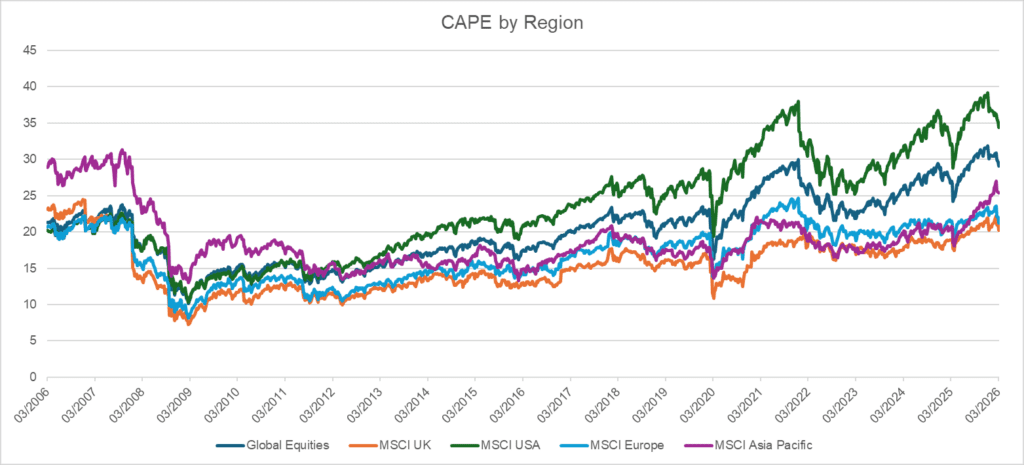
Past performance isn’t a guide to future returns. Source: Bloomberg, from 19/03/2006 to 22/03/2026.
The United States’ CAPE reading at just under 35 comes much higher than the UK and Europe, and is a large contributor to the global equities’ CAPE at 29.
3 ETF ideas for undervalued markets
Investors looking to diversify away from higher valuations in the US can do so by thinking about investing more in different regions and sectors.
However, investors also need to remember that just because a market seems more attractively valued (cheaper) compared to others, or even history, it doesn’t mean it’s better and will outperform. Sometimes investments are cheaper for a reason.
That said, investments with lower valuations can still help add some diversification to a portfolio, and offer the chance to help grow your wealth.
Here are 3 ETF ideas that can help investors get exposure to some more attractively-valued opportunities.
UK ETF: income from undervalued UK stocks
UK valuations remain at a discount to the US due to lower-than-expected growth, political headwinds and outflows.
The flip side to this is that investors can access a broad mix of global companies and internationally-diversified businesses at a discount to other markets.
The iShares UK dividend (IUKD) ETF aims to give investors exposure to companies in the UK that are known for paying higher‑than‑average dividends.
The companies included in this ETF are typically well‑established, stable businesses that have a track record of distributing profits to their shareholders.
Given the exposure to global economics of these businesses, investors wouldn’t be giving up too much of global diversification, but instead increasing exposure to global companies trading at more modest valuations.
Europe ETF: broad exposure to discounted markets
The same can be said in European stocks. While the region still looks more attractive from a valuation standpoint than the US, it’s important to note that Europe is home to many global leading companies in sectors like infrastructure, luxury goods, pharmaceuticals and industrials.
Europe has recently had to work through energy shocks and political uncertainties, but there are signs that profitability in the region and policy support are improving.
The Amundi Stoxx Europe 600 (MEUD) ETF aims to track the performance of the STOXX Europe 600, an index that represents 600 large, mid, and small‑cap companies from 17 European countries.
The index covers a wide range of sectors, providing broad exposure to the European economy.
Emerging Markets ETF: higher risk, long-term growth?
Emerging markets as a group generally trade on lower CAPE levels than developed markets. That’s because investing in emerging markets does bring extra risks like regulatory swings, volatile currencies, and political risks.
But they also offer structural growth drivers like rising middle-class consumption, infrastructure investment, and, in some cases, improving corporate governance.
For investors that are willing to tolerate more ups and downs, investing in emerging markets can complement a global equity tracker.
Emerging markets currently trade at 22 for CAPE, but certain regions are lower, like Brazil which trades at 12.
The iShares MSCI Brazil (IBZL) offers exposure to the region.
This ETF provides investors with targeted exposure to Brazilian equities by tracking the MSCI Brazil index.
This ETF focuses on large‑ and mid‑cap companies in Brazil, offering a way to invest in one of the largest emerging markets in Latin America and capture the performance of key sectors driving Brazil’s economy.
Just remember though, emerging markets are higher-risk investments and usually come with more volatility.
How to build a portfolio using these ETFs
One practical way investors can bring this all together is the core-satellite approach.
The ‘core’, for example, could be something broad, like a low-cost global equity exchange traded fund (ETF). An ETF like this offers diversified exposure across lots of different regions and sectors, ensuring investors remain fully invested and don’t rely on ‘big macro calls’.
Around that core, there’s room to invest in what we call satellite positions. These help add even more diversification to a portfolio and also allow you to invest in more specific themes or regions, without making you too exposed to one specific area.
For example, an investor might hold a global core, plus satellites in UK value, European quality, and an emerging markets value or small-cap fund, rebalanced a few times a year to avoid any single theme dominating the portfolio.
This keeps the overall strategy simple and rules-based, while providing a thoughtful way to respond to today’s stretched headline valuations, without trying to predict short-term market moves.
Value vs growth investing: what’s the difference? Plus 4 ETF ideas
ISA deadline 2026: there’s still time to use your £20,000 allowance
As the tax year end approaches, you have the opportunity to make the most of your ISA allowance before it resets.
You can invest up to £20,000 each tax year, but if you don’t use it by 5 April, you lose it — and you can’t carry it forward.
If you haven’t used yours yet, it’s worth exploring a Stocks and Shares ISA on InvestEngine — a simple, low-cost way to get your money invested and make the most of your tax-free allowance.
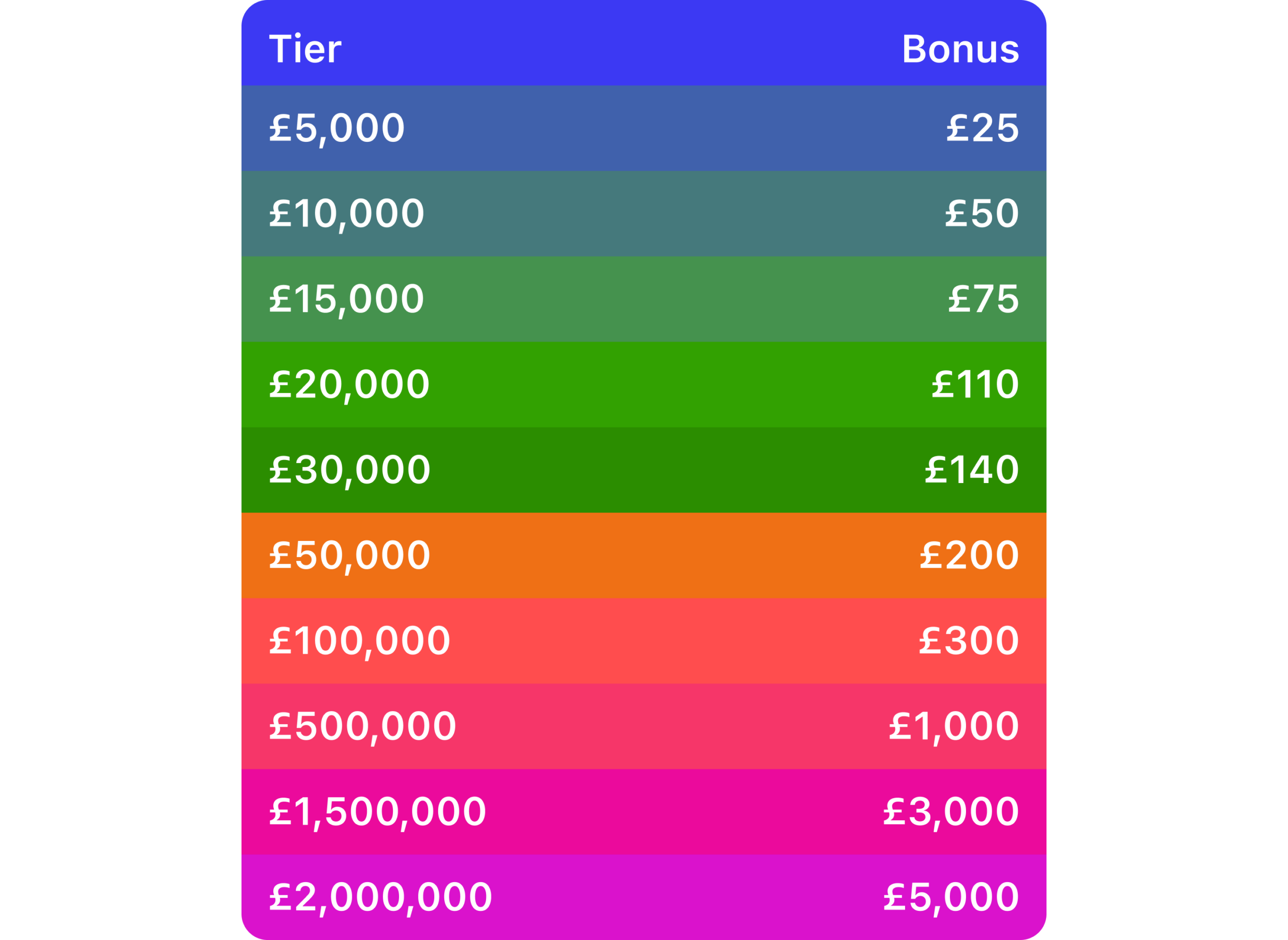
Get up to £5,000 when you transfer
It’s easy to transfer your existing ISA to InvestEngine for fee-free investing. You could also get up to £5,000 when you do switch. ETF costs apply. The bonus is tiered and requires your investment to remain invested for at least 12 months.
Find out moreCapital at risk. Ts&Cs apply
Before transferring, please review any fees, exit costs and whether your existing investments would need to be sold and reinvested into ETFs.
Important information
Capital at risk. The value of your investments may go down as well as up, and you may get back less than you invest. Past performance is not indicative of future performance.
ETF costs apply. Remember, ISA and tax rules can change and any benefits depend on individual circumstances. If in doubt, you may wish to consult a professional adviser for guidance.