


If you’re saving for retirement in the UK, there are a couple of options you might be aware of: the workplace pension and the self-invested personal pension (SIPP).
Both offer tax-efficient retirement investing. But they’re built for different types of investors.
In this guide, we’ll compare the InvestEngine SIPP with the Nest pension to help you understand the key differences in costs, flexibility, investment choice and control.
What is the InvestEngine SIPP?
A SIPP, or self-invested personal pension, is an investment portfolio that gives you control over how your retirement cash is invested.
The InvestEngine SIPP allows you to:
- Build your own portfolio from a range of hand-picked funds
- Automate your contributions for effortless long-term investing
- Rebalance and adjust your investments, for each stage of pension investing
Like all pensions, contributions benefit from tax relief. For most people, you can contribute up to £60,000 per tax year or 100% of your earnings, whichever is lower.
Any allowance you don’t use can be carried forward for up to three years.
The InvestEngine SIPP is designed for people who want more control and transparency over their retirement investments. We’ll get into why Nest doesn’t offer either, and what investors can do about it.
What is Nest?
Nest, or the National Employment Savings Trust, is a government-backed workplace pension scheme set up to support auto-enrolment.
If you’re employed, your employer will usually enrol you into a workplace pension such as Nest. Contributions are taken directly from your salary, and your employer must contribute too.
Nest is built to be simple:
- Most members are invested in a default fund
- Investment choice is very limited when compared with a SIPP
- It is designed for automated hands-off saving
For many employees, Nest is their first pension or the default option when they get a new employer.
How contributions work
Outside of investment choice and fees, probably the biggest difference between Nest and InvestEngine is the way in which you make contributions to your SIPP.
An InvestEngine SIPP is flexible
- You make personal contributions directly.
- You receive basic rate tax relief automatically.
- Higher-rate taxpayers may claim additional relief via self-assessment.
- Employers can also contribute.
- You can choose how much and how often you invest.
There is flexibility to increase, pause or reduce contributions.
The Nest pension is automatic
- Contributions are made through payroll.
- The legal minimum total contribution is currently 8% of qualifying earnings.
- At least 3% must come from your employer.
- You can choose to contribute more if you wish.
For employees, Nest ensures regular contributions without having to take action.
Investment choice and control
This is where the biggest difference lies. Because the Nest pension is the government-backed, default option for most employers, it shoots for broad appeal.
Nest primarily invests members into its default retirement date funds. These automatically adjust risk as you approach retirement.
There are a small number of alternative funds available, but the range is limited when compared with a SIPP.
Nest is designed to make decisions for you.
The InvestEngine SIPP offers more choice and control
With the InvestEngine SIPP, you have more choice when it comes to portfolio construction, risk level, and adjustments over time.
If Nest is designed to appeal to everyone, InvestEngine’s SIPP can be tailored to your specific needs. You can choose from a wide range of hand-picked investments, so your portfolio reflects your time horizon and your attitude to risk.
With a range of global, diversified funds for easy long-term investing, most people will find it easy to build a portfolio that suits them.
You decide what you invest in. That means more flexibility, but also more responsibility.
Nest fees compared
When you’re choosing where to put your investments for retirement, fees matter more than ever. Over such a long period, even a 0.5% difference can lead to a significant gap in the final total in a portfolio.
This is why InvestEngine’s SIPP comes with absolutely no platform fees. That means no trading fees, no withdrawal fees, no annual fees, or any fees other than the underlying ETF costs.
Here’s a breakdown of how InvestEngine and Nest compare when it comes to fees:
InvestEngine SIPP
- No platform fee for DIY portfolios
- No dealing fees or withdrawal fees
- Underlying ETF costs typically range from around 0.07% to 0.25%
With InvestEngine’s easy-to-use platform, you can see exactly what you’re invested in at a glance and easily see what each ETF costs.
Nest
- 1.8% on contributions
- 0.3% annual management charge on the total pot
While the annual fee is low, the contribution charge is something to consider over time. If you’re paying 1.8% on every monthly top up you make to your pension, this can have a major impact over the years or decades of investment.
As always, charges can change, and you should check the latest information from each provider.
Why fees matter
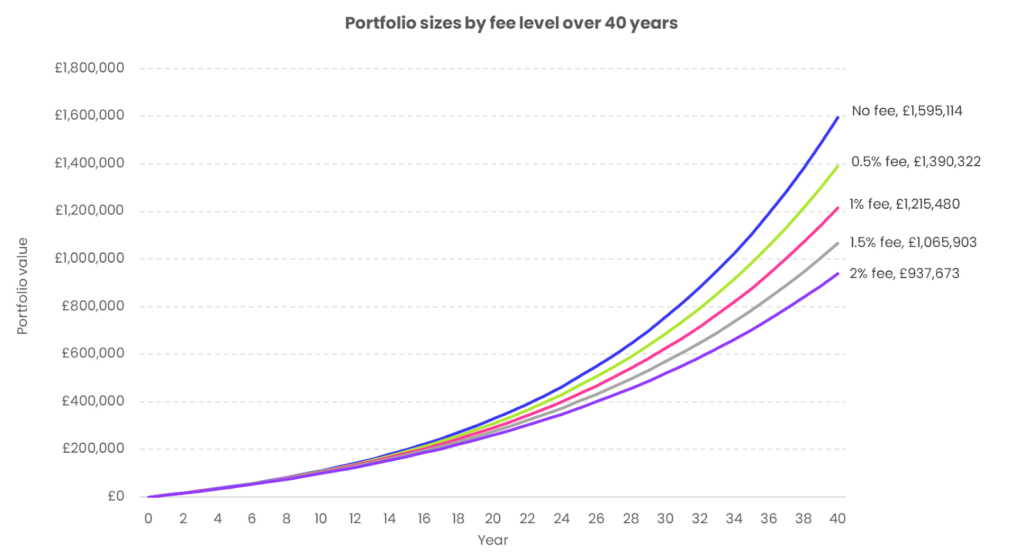
The chart below shows the impact of fees on a portfolio over 40 years, assuming total contributions (before government top-up or any reclaimed tax relief) of £400 per month and 7% gross returns:
Projections are hypothetical and for illustrative purposes only.
This portfolio would grow to over £1.5m with no fees, £1.2m with a 1% annual fee, and £940k with a 2% annual fee. The difference between the portfolio with no fees and the one with a 2% fee is over £600,000 – almost halving the portfolio’s final value.
The bottom line is that fees matter, and can have a huge impact on the size of a portfolio over time.
Access and flexibility at retirement
Both InvestEngine and Nest’s pension offerings are subject to UK pension rules.
Currently, you can usually access pension savings from age 55, rising to 57 in 2028.
InvestEngine SIPP
A SIPP typically offers:
- 25% tax-free lump sum (subject to limits)
- Flexible drawdown options
- Greater control over how and when you withdraw
Nest
Nest also offers retirement options, including drawdown, but with fewer flexibility features compared to many SIPPs. For example, on top of a lack of investment choice, Nest doesn’t offer flexi-access drawdowns. A lot of SIPPs (including InvestEngine’s) do offer this.
If flexibility at retirement is important, it’s worth reviewing the options carefully.
Can you transfer from Nest to a SIPP?
Yes, in many cases you can transfer pension savings from a workplace scheme like Nest into a SIPP. It’s important to note that you can only transfer from NEST once you have left the associated employment.
InvestEngine recently expanded its pension transfer service to include Nest portfolios. So, you can effortlessly move your workplace pension and get the clarity, control and choice your retirement pot deserves.
Common reasons people consider transferring include:
- Wanting wider investment choice
- Lower overall costs
- Consolidating multiple pensions
However, transfers are not suitable for everyone. You should consider:
- Whether you would lose valuable guarantees
- Any exit charges
- Whether you still benefit from employer contributions
It’s important to say here that this shouldn’t be taken as financial advice. If you’re unsure about what to do with your pension, consider seeking professional guidance.
Who might each option suit?
InvestEngine SIPP may suit you if:
- You want greater control over your investments
- You are focused on keeping investment costs low
- You are comfortable choosing from a range of ETFs to build a portfolio (we have guides to help you with this)
- You want to consolidate old pensions – this is usually most relevant if you’ve moved between a few different jobs
Nest may suit you if:
- You want a simple, automatic workplace pension that doesn’t require any input from you
- You prefer a default fund approach
- You do not want to manage investments yourself
Many people use both. For example, keeping their workplace pension for ongoing employer contributions while using a SIPP for additional retirement savings.
Final thoughts
Both the InvestEngine SIPP and Nest are tax-efficient ways to save for retirement. For most investors, the more you can put away for retirement, the better your outlook will be when you come to consider life after work.
The key differences are control and costs.
Nest focuses on simplicity and automatic saving through your employer. A SIPP gives you flexibility, transparency and investment choice.
The right option depends on your goals, your level of engagement, and how much control you want over your retirement savings.
Explore your options
If you’d like to take more control of your retirement investments, learn more about the InvestEngine SIPP and how it works.
Important information
Capital at risk. The value of your investments can go down as well as up, and you may get back less than you invest.
Tax treatment depends on personal circumstances and may change. This communication is for general information only and is not financial advice.